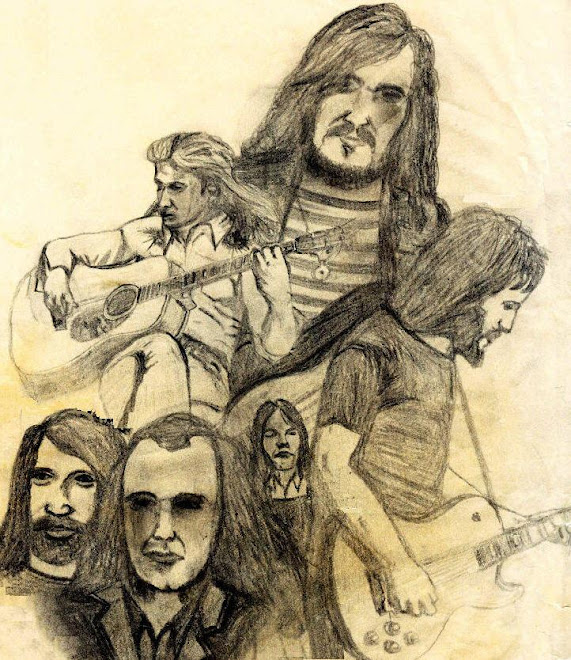
Looking at the music of Dutch rock band Focus, started in the late sixties by Thijs van Leer (b /31/03/48) with Jan Akkerman (b 24/12/46). Van Leer still performs and records under the name today (official site here). Akkerman's site here.

.

.
Showing posts with label Focus 3. Show all posts

20200926

Track 141 Focus 3 and 2 GO

Archive number: 141
Title: Focus 3 and 2 GO
Main Album: Golden Oldies
Track number: 6
Genre: Progressive Rock Instrumental
Studio: WedgeView Studios, Verlaat, The Netherlands
Length: 7:35
Composer: Thijs van Leer
Musicians: Thijs van Leer - Piano, Hammond organ, Menno Gootjes - Guitars, Bobby Jacobs - Bass, Pierre van der Linden - Drums
Producer: Bobby Jacobs
Engineer: Budy Mokoginta and Bram Boll
Label: Focus Music Ltd
Date of recording/release: 2014 CD also produced in vinyl format
Notes: An unusual combination of two Focus tracks

20151026

New edtion of Focus book

A new (third) edition of the book on Focus by Australian Peet Johnson arrived through my door the other day - Hocus Pocus: the strife and times of rock's Dutch masters. (See details here) Peet must know more about Focus than any man on earth and this new edition brings you right up to date with facts such as the version of Focus 3 done by Outkast and that by Guo Yue of House of the King (both in 1996). It's a bit expensive but hardcore Focus fans will go for it.

20080607

The Best Focus Album


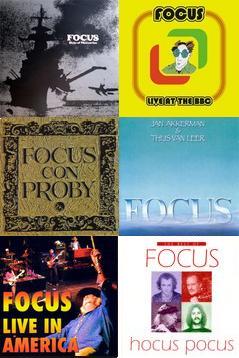
There are now around 17 Focus albums all told (if we include the three live albums - there is a fourth [Live in South America] not widely available).
In chronological order:

1. In and out
2. Moving Waves
3. Three
4. At the Rainbow (Live)
5. Hamburger Concerto
6. Mother Focus
7. Ship of Memories
8. Live at the BBC (Live)
9. Con Proby
10. Focus (1985)
11. Live in America (Live)
12. Eight
13. Focus 9/New skin
14. Focus X
15. Golden Oldies
16. Focus 8.5/Beyond the Horizon
17. Focus 11

Putting these in order of merit is not easy in some respects. Undoubtedly 2, 3 and 5 should be in the top three - but in what order? We all agree that Con Proby and Golden Oldies must come near the bottom. Here are two personal lists, the first only including studio albums, the second the live ones too.

1. Three
2. Hamburger
3. Waves
4. Ship
5. In & Out
6. 1985
7. Mother
8. New Skin
9. X
10. 11
11. Eight
12. 8.5
13. Proby
14. Oldies

1. Three
2. Hamburger
3. Waves
4. Rainbow
5. Ship
6. In & Out
7. 1985
8. Mother
9. New Skin
10. X 
11. 11
12. 8.5
13. BBC
14. Eight
15. America
16. Proby
17. Oldies

20080115

Track by track 22 Elspeth of Nottingham

Archive number: 22
Title: Elspeth of Nottingham
Main Album: Focus 3
Track number: 7 (CD version, 8 on the LP)
Genre: Elizabethan Instrumental
Studio: Olympic Studios 'B', 117 Church Road, Barnes, London SW13 9HL
Length: 03' 07”
Composer: Jan Akkerman (Mike Vernon gave it the title)
Musicians: Jan Akkerman – Lute; Thijs van Leer – Recorders; Pierre van der Linden – Drum
Producer: Mike Vernon
Engineer: George Chkiantz
Label: LP – Imperial, Polydor, Sire CD – EMI-Bovema, IRS, Red Bullet
Date of recording/release: July 1972/November 1972 CD - 1988, 1993, 2001
Notes: This is the first of two Focus tracks to feature Akkerman on the lute, although it does feature on some of his solo albums and was even used in live gigs of the time. This Akkerman penned piece in Elizabethan style is mainly lute but van Leer briefly adds recorders and van der Linden beats a drum at three points (01:02-01:11;01:57-02:16;02:37-02:57). The whole is enhanced throughout by Mike Vernon provided outdoor country sounds, mainly twittering birds but also a cow mooing (at the end)!
Note on the lute (from Wikipedia)
Lute can refer to any plucked string instrument with a neck and deep round back or a specific instrument from the family of European lutes. These and the Near-Eastern oud descend from a common ancestor (both words may be from Arabic al‘ud, the wood, though recent research suggests ‘ud may be Arabised Persian rud [string, stringed instrument, lute] or from Greek, Frankish or Slavonic words, meaning boat or ship). The lute is used in a great variety of instrumental music from early renaissance to late baroque. It is also an accompanying instrument, especially in vocal works. Lutenist, lutanist or lutist - Lute player. Luthier - Maker of lutes (or any string instrument). Lutes are made almost entirely of wood.
Soundboard: teardrop-shaped thin flat plate of resonant wood (usually spruce) nearly always with a single (sometimes triple) decorated soundhole under the strings (
the rose). It is covered with a grille in the form of an intertwining vine or decorative knot, carved directly out of the soundboard.
Back (shell): assembled from thin strips of hardwood (maple, cherry, ebony, etc) called ribs glued edge to edge to form a deep rounded body for the instrument. There are braces inside on the soundboard to give it strength.
Neck: light wood with hardwood veneer (usually ebony) providing durability for the fretboard beneath the strings, which is mounted flush with the top.
Pegbox: before the Baroque era it was angled back from the neck at almost 90°, presumably to help hold the low-tension strings firmly against the nut, which is not traditionally glued but held in place by string pressure only.
Tuning pegs: simple hardwood pegs, somewhat tapered, held in place by friction in holes drilled through the pegbox. With such instruments choice of wood here is crucial. As the wood suffers dimensional changes through age and loss of humidity, it must as closely as possible retain a circular cross-section in order to function properly, as there are no gears or other mechanical aids for tuning. Often pegs were made from suitable fruitwoods (eg European pearwood) or similar. Matheson (c 1720) wrote that if a lute-player who lives 80 years, will spend 60 tuning. [Why Akkerman practically gave up on the lute in the end].
Belly: its geometry is relatively complex, involving a system of barring in which braces are placed perpendicular to the strings at specific lengths along the belly's overall length, the ends of which are angled quite precisely to abut the ribs on either side for structural reasons. It seems ancient builders placed bars according to whole-number ratios of the scale length and belly length. The inward bend of the soundboard ('belly scoop') is probably a deliberate adaptation by ancient builders to afford the lutenist's right hand more space between strings and soundboard. Belly thickness varies, but usually is 1.5-2 mm. Some luthiers tune the belly as they build, removing mass and adapting bracing to ensure proper sonic results. The belly is almost never finished, though a luthier may size the top with a very thin coat of shellac or glair in order to help keep it clean. The belly is joined directly to the rib, without a lining glued to the sides, although a cap and counter cap are glued to the inside and outside of the bottom end of the bowl to provide rigidity and increased gluing surface. After joining top to sides, a half-binding is usually installed around the belly's edge. It is approximately half the thickness of the belly and is usually made of a contrasting colour wood. The rebate for the half-binding must be extremely precise to avoid compromising structural integrity.
Bridge: usually of fruitwood, it is attached to the soundboard at 1/5-1/7 the belly length. It does not have a separate saddle but has holes bored into it to which the strings attach directly. Typically it is made such that it tapers in height and length, with the small end holding the trebles and the higher and wider end carrying the basses. Bridges are often colored black with carbon black in a binder, often shellac, and often have inscribed decoration. The scrolls or other decoration on the ends of lute bridges are usually integral.
Frets: made of loops of gut (or nylon) tied round the neck, they fray with use and must be replaced. A few additional partial frets of wood are usually glued to the body, to allow stopping the highest-pitched courses up to a full octave higher than the open string, though not on original instruments. Many luthiers prefer gut to nylon, as it conforms more readily to the sharp angle at the edge of the fingerboard.
Strings: historically of gut (sometimes in combination with metal) gut is till used or nylon, with metal windings on the lower-pitched strings. Gut is more authentic, though more susceptible to irregularity and pitch instability due to changes in humidity. Nylon, less authentic, offers greater tuning stability but is of course anachronistic.
Of note are the "catlines" used as basses on historical instruments. Catlines are several gut strings wound together and soaked in heavy metal solutions which increase string mass. They can be quite large in diameter by comparison with wound nylon strings for the same pitch. They produce a bass which is somewhat different in timbre from nylon basses.
The lute's strings are arranged in courses (usually 2 strings each, though the highest-pitched course usually consists of only a single string, the chanterelle). In later Baroque lutes 2 upper courses are single. The courses are numbered sequentially, counting from the highest pitched, so that the chanterelle is the first course, the next pair the second course, etc. Thus an 8-course Renaissance lute usually has 15 strings; a 13-course Baroque lute will have 24.
The courses are tuned in unison for high and intermediate pitches, but for lower pitches one of the two strings is tuned an octave higher. (The course at which this split starts changed over time.) The two strings of a course are virtually always stopped and plucked together, as if a single string, but very rarely a piece calls for the two strings of a course to be stopped and/or plucked separately. The tuning of a lute is somewhat complicated. The result of the lute's design is an instrument extremely light for its size.
Medieval lutes were 4- or 5-course instruments, plucked using a quill for a plectrum. There were several sizes, and by the end of the Renaissance, 7 different sizes (up to the great octave bass) are documented. Song accompaniment was probably the lute's primary function in the Middle Ages, but very little music securely attributable to the lute survives from the era before 1500. Medieval and early-Renaissance song accompaniments were probably mostly improvised, hence the lack of written records.
In the last few decades of the 15th century, in order to play Renaissance polyphony on a single instrument, lutenists gradually abandoned the quill in favor of plucking the instrument with the fingertips. The number of courses grew to 6 or more. The lute was the premier solo instrument of the 16th century, but continued to be used to accompany singers as well.
By the end of the Renaissance the number of courses had grown to 10. During the Baroque era it continued to grow, reaching 14 (occasionally 19). These instruments, with up to 26-35 strings, required innovations in structure. At the end of the lute's evolution the archlute, theorbo and torban had long extensions attached to the main tuning head in order to provide a greater resonating length for the bass strings, and as human fingers are too short to stop strings across a neck wide enough to hold 14 courses, the bass strings were placed outside the fretboard, and were played "open", ie without fretting/stopping them with the left hand.
Throughout the Baroque era the lute was increasingly relegated to continuo accompaniment and was eventually superseded in that role by keyboards. It fell out of use after 1800 but enjoyed a revival with the awakening of interest in historical music around 1900 and later. That revival was boosted by the 20th century early music movement. Important pioneers in lute revival were Julian Bream [an influence on Akkerman] Hans Neemann, Walter Gerwig, Suzanne Bloch and Diana Poulton.

20080114

Track by track 21 Answers? Questions! Questions? Answers!

Archive number: 21
Title: Answers? Questions! Questions? Answers!
Main Album: Focus 3
Track number: 6
Genre: Progressive Jazz Rock Instrumental
Studio: Olympic Studios 'B', 117 Church Road, Barnes, London SW13 9HL
Length: 13' 50"
Composer: Bert Ruiter, Jan Akkerman
Musicians: Jan Akkerman – Electric guitars (Gibson Les Paul Customs?); Thijs van Leer – Hammond organ, Flute; Bert Ruiter - Bass; Pierre van der  Linden – Drums (brushes and sticks)
Producer: Mike Vernon
Engineer: George Chkiantz
Label: LP – Imperial, Polydor, Sire CD – EMI-Bovema, IRS, Red Bullet Date of recording/release: July 1972/November 1972 CD - 1988, 1993, 2001
Alternative version: A live version can be heard on the Rainbow album. Akkerman has played it live. Notes: Jan Akkerman apparently had a sound stage built in the studio for Focus 3 and once again here is a track that chiefly has a very live sound, though there are some overdubs. The song was being played by Focus from Ruiter's arrival and he gets a credit. The idea of musical calls and responses is a common one in jazz and it forms the basis of much of the Focus repertoire. Here, slightly differently, the response or answer precedes the call or question. The opening section (00:00-01:21) begins with Ruiter's bass riff, which gives the track its initial impetus. Bass and guitar play in unison backed by snare, cymbals and a struck high hat. From 00:19 a swelling Hammond vibrato pans out across the sound spectrum. At 00:37 the guitar cuts in to form a bridge to the point where the Hammond takes up the lead (00:47) until replaced again by a jazzy guitar (01:21). The section is brought to a close by four decisive chords. This first section is then partly repeated but with no lead organ and a longer guitar-led section that ends again with the decisive chords plus a thrice-repeated riff or scale and a repeated drum beat (01:22-02:51). A short third section (02:52-03:58) is led first by the guitar, now in plaintive mood and dubbed over the existing track which also features guitar, and then (from 03:27) by the organ. At 03:59 a sombre and mysterious mood is introduced and we come to a lengthy flute-led section (03:59-08:06). Again there is evidence of some overdubbing to achieve this. The guitar provides a subtle undercurrent until (around 06:59) it becomes a little harder and more insistent and the atmosphere becomes less mysterious and more heavy. By 08:07 we are into a new guitar-led section that is increasingly heavy and ever wilder, with Akkerman moving up and down the fretboard with some dexterity. This lasts until around 11:25 where there is an unexpected change in the style. A final section (11:27-13:50) is then led by a weeping or 'violined' guitar. This slower section ends with a virtually solo but multi-tracked guitar riff that breaks down at the end, the one guitar letting out a final long-drawn-out note that employs feedback to sustain itself for over 20 seconds. The influence of Django Reinhardt has been observed with regard to this piece but certainly Jimi Hendrix has also had a strong influence on the guitar work too. On the original vinyl LP 5 seconds of manic laughter can be heard in the distant background after this, at the close of the second side of the album. On the CD version this is now attached to the beginning of the track that follows (Elspeth of Nottingham).

20080104

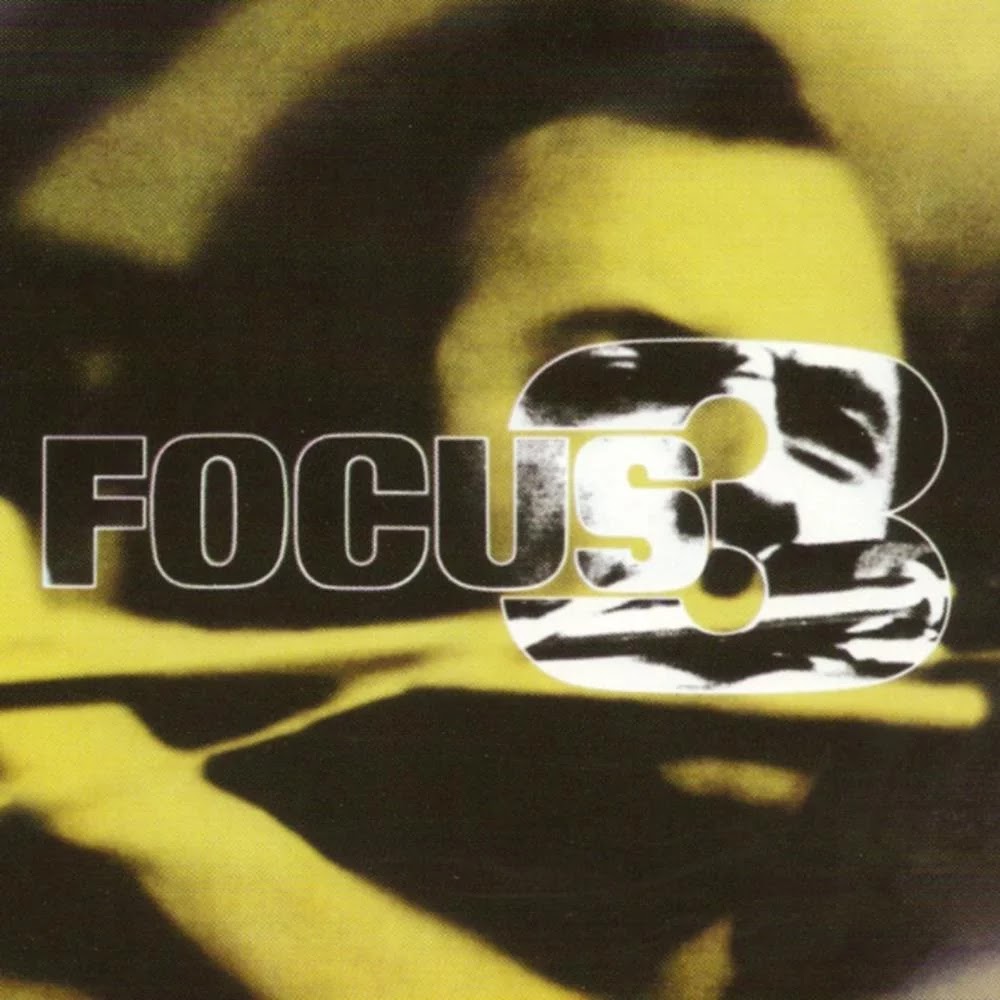
Track by track 20 Focus 3

Archive number: 20
Title: Focus 3
Main Album: Focus 3
Track number: 5
Genre: Jazz Rock Instrumental
Studio: Olympic Studios 'B', 117 Church Road, Barnes, London SW13 9HL
Length: 06' 04"
Composer: Thijs van Leer
Musicians: Jan Akkerman – Electric guitars (Gibson Les Paul Customs?); Thijs van Leer – Hammond organ; Bert Ruiter - Bass; Pierre van der Linden – Drums (chiefly using brushes)
Producer: Mike Vernon
Engineer: George Chkiantz
Label: LP – Imperial, Polydor, Sire CD – Capitol, EMI-Bovema, IRS, Red Bullet, JVC Victor
Date of recording/release: July 1972/November 1972, 1975 CD - 1988, 1993, 2001, 2002, 2004
Alternative versions: A live version appears on Focus at the Rainbow. Van Leer also rearranged the track for the second Introspection album. Akkerman has featured it in his live act. All the Focus tracks were re-recorded for the fiftieth anniversary album. Outkast sampled the track for their Wheels of Steel track.
Notes: This, the third in the Focus series, begins with just organ (00:00-00:18) mainly repeating the notes B, C#, D, F# (a much loved sequence). At 00:19 the bass and guitar join the organ. At 00:40 the drums join in and soon the guitar is being 'violined'. This quiet, laid back style continues, repeating the earlier material, until at 02:05 the volume rises and at 02:18 a more swinging and intense style comes in, one often compared with part of Petula Clark's Don't sleep in the subway by Tony Hatch with Jackie Trent. (Cf 00:35-00:50 on that track, where she sings “I’ve heard it all a million times before; take off your coat, my love, and close the door” and 01:44-01:58 where she sings "Goodbye means nothing when it's all for show; so why pretend you've somewhere else to go"). This is repeated, bringing us to 03:10. The band then switch back to the earlier quieter style, 03:11-05:11. This slowly rises, especially from about 05:00, to something of a climax at 05:11. In 05:12-05:41 high notes on the guitar play against the bass and drums in that soaring Focus style to be followed by much lower notes (05:34-05:41). The higher part is then repeated (05:42-06:04) ending on a hanging guitar note ready for the immediate succession of the next track. Once again the feel is very much a live one.

20080103

Track by track 19 Carnival Fugue

Archive number: 19
Title: Carnival Fugue
Main Album: Focus 3
Track number: 4
Genre: Jazz Rock Instrumental
Studio: Olympic Studios 'B', 117 Church Road, Barnes, London SW13 9HL
Length: 06' 04"
Composer: Thijs van Leer
Musicians: Jan Akkerman – Electric guitars (Gibson Les Paul Customs?), acoustic guitar; Thijs van Leer – Hammond organ, piano, piccolo; Bert Ruiter - Bass; Pierre Van Der Linden – Drums
Producer: Mike Vernon
Engineer: George Chkiantz Label: LP – Imperial, Polydor, Sire CD – Capitol, EMI-Bovema, IRS, Red Bullet, JVC Victor
Date of recording/release: July 1972/November 1972, 1975 CD - 1988, 1993, 2001, 2002, 2004
Alternative version: There does not appear to be a different version of this anywhere but some sections were later used by van Leer in quite a different (more obviously fugal) way on the 1981 Pedal Point album Dona Nobis Pacem (in the first Sanctus).
Notes: The piece can be divided into four sections. The first (00:00-01:30) is slow and solemn and features piano, electric guitar and very sparing drum fills using floor toms and cymbals. The piece begins just with piano but is complimented by laid back, meandering guitar lines. The music evokes the lack of activity before a carnival march starts. There is a four second gap between the first and second section (00:31-00:34). The second section (01:35-02:55) features piano again but now with acoustic guitars from the start and (from 00:49) bass and drums. This brisker section features rising scales and evokes perhaps the readying of carnival marchers. This leads into a third even quicker, more jazzy (or contrapuntal) transitional section (02:56-03:29) on the same instruments. By now the whole troupe is more than ready for the off and the final section is a lively 'carnival' style one, Caribbean perhaps, in its feel (03:30-06:04). It features piccolo, organ, electric guitar, bass and drums. An infectious joy permeates as the music eventually fades, the revellers, as it were, passing into the distance. Overdubbing has been used to enhance the piccolo lines and contrasting guitar lines come from the two channels at certain points.
A note on the term fugue (from Wikipedia) The English term fugue originates in the 16th Century and is from French or Italian fuga, which itself is from Latin and is related to both fugere (to flee) and fugare (to chase). The adjectival form is fugal. Variants include fughetta (lit a small fugue) and fugato (passage in fugal style within another work that is not a fugue). In music, a fugue is a type of contrapuntal composition or technique of composition for a fixed number of parts, normally referred to as "voices", irrespective of whether the work is vocal or not. In the Middle Ages, the term was widely used to denote any works in canonic style; by the Renaissance, it came to denote specifically imitative works. Since the 17th Century the term has described what is commonly regarded as the most fully developed procedure of imitative counterpoint. A fugue opens with one main theme (subject) which then sounds successively in each voice in imitation; when each voice has entered, the exposition is complete; usually this is followed by a connecting passage (episode) developed from previously heard material; further "entries" of the subject then are heard in related keys. Episodes and entries are usually alternated until the "final entry" of the subject, by which point the music has returned to the opening key, or tonic, which is often followed by closing material, the coda. In this sense, fugue is a style of composition, rather than a fixed structure. Though there are certain established practices, in writing the exposition for example, composers approach the style with varying degrees of freedom and individuality. The form evolved from several earlier types of contrapuntal compositions, such as imitative ricercars, capriccios, canzonas and fantasias. Middle and late Baroque composers such as Buxtehude (1637–1707) and Pachelbel (1653–1706) contributed greatly to the development of the fugue, and the form reached ultimate maturity in the works of Bach (1685–1750). With the decline of sophisticated contrapuntal styles at the end of the baroque period, the fugue's popularity as a compositional style waned, eventually giving way to Sonata form. Nevertheless, composers from the 1750s to the present day continue to write and study fugue for various purposes; they appear in the works of Mozart (eg Kyrie Eleison, Requiem in D min) and Beethoven (eg end of Credo, Missa Solemnis) and composers such as Reicha (1770–1836) and Shostakovich (1906–1975) wrote cycles of fugues.

20080102

Track by track 18 Love Remembered

Archive number: 18
Title: Love Remembered
Main Album: Focus 3 (also a single in 1972)
Track number: 2
Genre: Classical/Progressive Rock Instrumental
Studio: Olympic Studios 'B', 117 Church Road, Barnes, London SW13 9HL
Length: 2' 45”
Composer: Jan Akkerman
Musicians: Jan Akkerman – Acoustic guitars; Thijs van Leer – Flute, Synthesizer, Voice; Bert Ruiter - Bass; Pierre van der Linden – Drums
Producer: Mike Vernon
Engineer: George Chkiantz
Label: LP – Imperial, Polydor, Sire CD – Capitol, EMI-Bovema, IRS, Red Bullet , JVC Victor
Date of recording/release: July 1972/November 1972, 1975 CD - 1988, 1993, 2001, 2002, 2004
Alternative version: A version by Toots Thielemans appeared subsequently and Akkerman himself later re-recorded the track in a very laid back style with Claus Ogerman and his orchestra (Aranjuez).
Notes: This beautiful piece opens with acoustic guitars that continue throughout the piece. Some seconds in, the flute takes up the main theme, backed by a high wind-like flute provided by a studio synthesizer. At 01:19 two beats from the drums, which were in the background until this point signal a new phase and van Leer's voice and more cymbals can be heard. The song builds from here with a great yearning, breaking down a little around 01:58 but finding some sort of resolve by 02:16 and returning to the opening style. We end with an extended flute note followed by a muted final chord from a guitar so leaving way on the album for the opening chords of Sylvia, the next track.

20071224

Track by track 17 Round goes the gossip

Archive number: 17
Title: Round goes the gossip
Main Album: Focus 3
Track number: 1
Genre: Jazz Rock Instrumental/Vocal
Studio: Olympic Studios 'B', 117 Church Road, Barnes, London SW13 9HL
Length: 5' 12"
Composer: Thijs van Leer
Musicians: Jan Akkerman – Electric guitars (Gibson Les Paul Customs?); Thijs van Leer – Hammond organ, Vocals, Speaking voice; Bert Ruiter - Bass; Pierre van der Linden – Drums; Mike Vernon, George Chkiantz - Vocals
Producer: Mike Vernon
Engineer: George Chkiantz
Label: LP – Imperial, Polydor, Sire CD – Capitol, EMI-Bovema, IRS, Red Bullet , JVC Victor
Date of recording/release: July 1972/November 1972, 1975 CD - 1988, 1993, 2001, 2002, 2004
Notes: This pretty unique offering begins with drums (00:00-00:08). The band then come in (00:17-00:35) followed by a multi-tracked and reverbed chant of the lyric 'Round goes the gossip' (00:36-00:51). Band and vocal alternate (00:52-01:02; 01:03-01:19; 01:20-01:29) until a quieter section, beginning at 01:30, where (01:40-02:31) appropriate words from Virgil's Aeneid (Book 4 lines 173-177), as below, are intoned in Latin by van Leer. The words are again multi-tracked and have strong reverb. The drums then bring in the chanted vocal again (02:32-02:54) to be followed by another instrumental break on guitar and organ with the rhythm section (02:55-03:14). The lyric is then given out just once (03:15-03:18) and a change of pace follows with a stop, start section (03:19-04:22) that includes some furious jazz guitar bringing us to a final section (04:23-05:12) where the vocal reasserts itself in an increasingly disjointed and manic way until a fade beginning around 4:42. The Latin words are
Extemplo libyae magnas it fama per urbes, Fama, malum qua non aliud velocius ullum. Mobilitate viget virisque adquirit eundo; Parva metu primo, mox sese attollit in auras. Ingrediturque solo et caput inter nubila condit.
[Forthwith rumour runs through Libya's great cities - Rumour of all evils the most swift. Speed lends her strength, and she wins vigour as she goes; Small at first through fear, soon she mounts up to heaven, And walks the ground with head hidden in the clouds.]
Note on the Aeneid (from Wikipedia)
The Aeneid is a Latin epic written by Virgil in the 1st Century BC (29-19 BC). It tells the legendary story of Aeneas, a Trojan who travelled to Italy and became ancestor to the Romans. It is written in dactylic hexameter. The poem's first 6 books (of 12) tell of Aeneas' wanderings from Troy to Italy. The second half treats the Trojans' ultimately victorious war against the Latins, under whose name Aeneas and his Trojan followers are destined to be subsumed. The hero Aeneas was already known to Graeco-Roman legend and myth, having been a character in the Iliad. Virgil took the disconnected tales of his wanderings, his vague association with Rome's foundation and a personage of no fixed characteristics other than a scrupulous piety, and fashioned this into a compelling founding myth or nationalist epic that at once tied Rome to the legends of Troy, glorified traditional Roman virtues and legitimised the Julio-Claudian dynasty as descendants of the founders, heroes and gods of Rome and Troy.

Track by track 16 Sylvia

Archive number: 16
Title: Sylvia
Main Album: Focus 3 (also a single in 1972 and 1973)
Track number: 3
Genre: Jazz Rock Instrumental
Studio: Olympic Studios 'B', 117 Church Road, Barnes, London SW13 9HL
Length: 03' 24"
Composer: Thijs van Leer
Musicians: Jan Akkerman – Electric guitars (Gibson Les Paul Customs?); Thijs van Leer – Hammond organ, Voice; Bert Ruiter - Bass; Pierre Van Der Linden – Drums
Producer: Mike Vernon
Engineer: George Chkiantz
Label: LP – Imperial, Polydor, Sire CD – Capitol, EMI-Bovema, IRS, Red Bullet, JVC Victor
Date of recording/release: July 1972/November 1972, 1975 CD - 1988, 1993, 2001, 2002, 2004
Alternative version: A live version appears on the Rainbow album. Van Leer has done acoustic versions (Hommage aan Rogier van Otterloo, etc). Akkerman likes to do what he calls Sylvia's grandmother emphasising his own contribution to the original hit. There have been some covers.
Notes: Apparently this was always intended as a single and so was probably recorded before the other material for Focus 3. One of Focus's most famous tracks, still played on the radio today, it was originally written by van Leer in the late sixties for Sylvia Alberts, when both were working as backing singers for Ramses Shaffy and Liesbeth List. The original piece used a lyric by Linda van Dijk, beginning "I thought I could do everything on my own, I was always stripping the town alone" (!). Alberts did not like the track and so it was shelved until being dusted down and used by Focus in its instrumental form. The Focus track begins with that famous jazz riff on guitars, reminiscent of the work of David T Walker, Louis Shelton and Don Peake on the 1969 Jackson 5 hit I want you back. The ambience is enhanced by heavy reverb from the one channel acting as a sort of drone against the chopped chords. (This is not found on live versions, of course). The organ and bass join in (00:09) then drums (00:15). The whole opening section lasts until 00:24, when the guitar leads the band into the main theme (00:25-00:42). The chopped chords then return (00:43-00:50) to be followed once again by the guitar-led theme (00:51-01:47). At 01:09-01:12 there is a brief bridge that features again at 01:48-02:00 where it is repeated three times, accompanied by van Leer's vibrato voice. In 02:01-02:45 we visit the main theme once again (note the distinctive variation around 02:18). This leads to a false ritartando ending when the chopped chords break in for the last time (02:46-02:54) again joined first by organ and bass (02:55-03:01) then drums (03:02-03:24) before the fade.