|
| Double Click |
.

Showing posts with label Ruiter. Show all posts
Showing posts with label Ruiter. Show all posts
20091218


20081201
Focus Vocalists

Surprisingly, perhaps, there are over 20 Focus vocal tracks of various sorts. Most of these feature Thijs Van Leer but there are a number of P J Proby vocals, of course, on the Focus Con Proby album and Bert Ruiter sang I need a bathroom on Mother Focus (though it is sometimes said that it is Akkerman). Akkerman can certainly be heard with Van Leer on Avondrood. Cyriel Havermans's voice is heard on Moving Waves. Jan Dumee sings briefly on Focus 8. On Focus 9 Jo de Roeck sings Just like Eddy.
Focus Bassists

Of these there are really four. The current player is Bobby Jacobs. The longest serving was Bert Ruiter. The first was Martijn Dresden. On Moving Waves the credit goes to the man best known as Cyriel Havermans, although Jan Akkerman apparently did most of it. One also ought to mention Tato Gomez on the first four tracks of the 1985 Van Leer Akkerman album and Ruud Jacobs and his double bass on Beethoven's Revenge from that album.
20080613
Track by track 61 Blues in D (Live)
Archive number: 61
Title: Blues in D (Live)
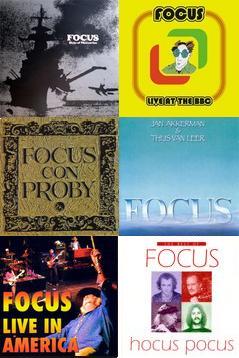
Main Album: Live at the BBC
Track number: 2
Genre: Live Jazz Rock Instrumental
Venue: New Victoria Theatre, 17 Wilton Road, London SW1V 1LL (now Apollo Victoria)
Length: 3' 46”
Composer: Bert Ruiter
Musicians: Philip Catherine - Electric guitar; Thijs van Leer – Mellotron, Electric Piano; Bert Ruiter – Bass; David Kemper - Drums
Producer: BBC
Engineer: BBC
Label: Hux Records
Date of recording/release: Recorded March 21 1976 but only released (on CD) June 1 2004
Notes: We begin with the drums and straight away the band is into a keyboard led (electric piano over mellotron) groove as strummed guitar, bass and drums accompany (00:00-00:51). A guitar chord then breaks in and proceedings hang a little as the riff is repeated until the original groove is re-established (00:52-01:30). A crisp guitar next takes up the lead role in a similar jazzy exploratory style (01:31-03:00) the rhythm never failing all the while. At the three minute mark the electric piano briefly comes back in (03:01-03:11) but the guitar is soon back and leads the descent into the close of the piece (03:12-03:35). Applause follows and van Leer can be heard saying 'thank you' (00:36-03:46).
A note on the Blues (from Wikipedia)
Blues is a vocal and instrumental music form based on the use of the blue notes. It emerged in African-American communities of the USA from spirituals, work songs, field hollers, shouts and chants and rhymed simple narrative ballads. The use of blue notes and the prominence of call and response patterns in the music and lyrics are indicative of African influence. The blues influenced later American and Western popular music, as it became the roots of jazz, R& B, rock, etc, etc.
The phrase "the blues" is a reference to the blue devils, meaning 'down' spirits, depression and sadness. An early reference to "the blues" can be found in George Colman's farce Blue devils, a farce in one act (1798). Later during the 19th Century, the phrase was used as a euphemism for delirium tremens and the police and was not uncommon in letters from homesick Civil War soldiers.
Though the use of the phrase in African-American music may be older, it has been attested to since 1912, when Hart Wand's Dallas Blues became the first copyrighted Blues composition. In lyrics the phrase is often used to describe a depressed mood.
There are few characteristics common to all blues, because the genre takes its shape from the idiosyncrasies of individual performances. However, there are some characteristics that were present long before the creation of the modern blues.
An early form of blues-like music were call-and-response shouts, which were a "functional expression ... style without accompaniment or harmony and unbounded by the formality of any particular musical structure." A form of this pre-blues was heard in slave field shouts and hollers, expanded into "simple solo songs laden with emotional content". The blues, as now known, can be seen as a musical style based on both European harmonic structure and the African call-and-response tradition, transformed into an interplay of voice and guitar.
Many blues elements, such as the call-and-response format and the use of blue notes, can be traced back to the music of Africa. The Diddley bow, a homemade one-stringed instrument found in parts of the American South in the early 20th Century and the banjo are African-derived instruments that may have helped in the transfer of African performance techniques into the early blues instrumental vocabulary.
During the first decades of the 20th Century blues music was not clearly defined in terms of a chord progression. There were many blues in 8-bar form, such as "How Long Blues", "Trouble in Mind" and Big Bill Broonzy's "Key to the Highway." Idiosyncratic numbers of bars are also encountered occasionally, as with the 9 bar progression in Howlin Wolf's's "Sitting on top of the world". The basic 12-bar lyric framework of a blues composition is reflected by a standard harmonic progression of 12 bars, in 4/4 or (rarely) 2/4 time. Slow blues are often played in 12/8 (4 beats per measure with 3 subdivisions per beat). By the 1930s, 12-bar blues became the standard. There would also be 16 bar blues, as in Ray Charles's instrumental "Sweet 16 Bars", and in Herbie Hancock's "Watermelon Man".
20080605
Track by track 54 Tropic Bird
Archive number: 54
Title: Tropic Bird
Main Album: Mother Focus
Track number: 6
Genre: Laid back Jazz Instrumental
Studio: Decca Studios, Hollywood, Los Angeles, California (later Studio 55)
Length: 2' 38”
Composer: Bert Ruiter
Musicians: Thijs van Leer – Electric piano, Flute, Mellotron; Bert Ruiter – Bass; David Kemper - Drums
Producer: Hubert Terheggen/Focus
Engineer: Eric Prestidge
Label: LP – Polydor, Atco, Philips, EMI
Date of recording/release: Recorded 1975, released October 1975. LP – 1975, 1977, CD - 1988
Notes: This extremely laid back mood piece features van Leer's keyboards and flute backed by brushed drums and bass. Akkerman appears to be absent.
Title: Tropic Bird
Main Album: Mother Focus
Track number: 6
Genre: Laid back Jazz Instrumental
Studio: Decca Studios, Hollywood, Los Angeles, California (later Studio 55)
Length: 2' 38”
Composer: Bert Ruiter
Musicians: Thijs van Leer – Electric piano, Flute, Mellotron; Bert Ruiter – Bass; David Kemper - Drums
Producer: Hubert Terheggen/Focus
Engineer: Eric Prestidge
Label: LP – Polydor, Atco, Philips, EMI
Date of recording/release: Recorded 1975, released October 1975. LP – 1975, 1977, CD - 1988
Notes: This extremely laid back mood piece features van Leer's keyboards and flute backed by brushed drums and bass. Akkerman appears to be absent.
Track by track 53 Hard Vanilla
Archive number: 53
Title: Hard Vanilla
Main Album: Mother Focus
Track number: 5
Genre: Progressive Rock Instrumental
Studio: Decca Studios, Hollywood, Los Angeles, California (later Studio 55)
Length: 2' 36”
Composer: Bert Ruiter
Musicians: Jan Akkerman – Acoustic guitars, Electric guitars with talkbox; Thijs van Leer – Electric piano?; Bert Ruiter – Bass; David Kemper - Drums
Producer: Hubert Terheggen/Focus
Engineer: Eric Prestidge
Label: LP – Polydor, Atco, Philips, EMI
Date of recording/release: Recorded 1975, released October 1975. LP – 1975, 1977, CD - 1988
Notes: This harder edged counterpart to the previous track has the band dominated by guitars – acoustic guitars and especially the talkbox. The main theme is repeated several times until we reach a coda that winds down before going a little wild then fading (02:10-02:31).
20080604
Track by track 52 Soft Vanilla
Archive number: 52
Title: Soft Vanilla
Main Album: Mother Focus
Track number: 4
Genre: Light Jazz Instrumental
Studio: Decca Studios, Hollywood, Los Angeles, California (later Studio 55)
Length: 3' 01”
Composer: Bert Ruiter
Musicians: Jan Akkerman - Electric guitars; Thijs van Leer – Electric piano, Synthesiser, Mellotron; Bert Ruiter – Bass; David Kemper - Drums
Producer: Hubert Terheggen/Focus
Engineer: Eric Prestidge
Label: LP – Polydor, Atco, Philips, EMI
Date of recording/release: Recorded 1975, released October 1975. LP – 1975, 1977, CD - 1988
Notes: This gentle song begins with van Leer's synthesiser (00:00-00:25) but is succeeded by his flute (00:26-01:30). Gentle chopped guitar joins the rhythm section as backing. A harder edged keyboard section comes in (01:31-01:55) to be succeeded by the flute again and then coming to a halt (01:56-03:01). Like the name it is all very light and sweet.
20080530
Track by track 46 I need a bathroom
Archive number: 46
Title: I need a bathroom
Main Album: Mother Focus
Track number: 2
Genre: Rock Vocal
Studio: Morgan Studios, Brussels, Belgium
Length: 3' 03”
Composer: Bert Ruiter
Musicians: Jan Akkerman - Electric guitars; Thijs van Leer – Electric piano, Mellotron; Bert Ruiter – Bass, Vocals; Colin Allen - Drums
Producer: Hubert Terheggen/Focus
Engineer: Eric Prestidge
Label: LP – Polydor, Atco, Philips, EMI
Date of recording/release: Recorded 1975, released October 1975. LP – 1975, 1977, CD - 1988
Notes: This appears to be a humorous parody of early disco - increasingly popular at the time. After a brief introduction featuring guitars, a voice, the piano and finally drums and bass (00:00-00:12) the vocal begins and takes up most of the time (00:13-02:55) with just a few very short breaks. The lyrics are (something like)
Oh I need the bathroom
Oh I need the bathroom
Oh keep on fighting
Oh I need the bathroom
And oh it's keeping on
Oh keep on fighting
Oh I need a bathroom
We're 'bout keeping on
Oh keep on fighting
And you keep me on
Then call again to Alaro* Maybe things will change, things tomorrow,
And call again - keeping on
Oh I need a bathroom
Oh I need a bathroom
Oh keep on fighting
Oh
And yet it seems tomorrow may be'll change things -
I don't know if you're right
Oh keep on rocking
Oh keep on fighting
Oh
The piece finally stumbles out rather than fading or ending with a flourish (02:56-03:03).
*Alaro is in Majorca. Bert Ruiter's girl friend of the time was there, only available by 'phone.
A note on Disco (from Wikipedia)
Most people agree that the first disco songs were released in 1973, though some suggest earlier examples. The first article about disco appeared in Rolling Stone in September 1973. In 1974 New York City's WPIX-FM premiered the first disco radio show. Musical influences include funk, soul, salsa and the Latin or Hispanic musics which influenced salsa. The disco sound has a soaring, often reverberated vocals over a steady four on the floor beat, a quaver or semi-quaver hi-hat pattern with an open hi-hat on the off-beat, and prominent syncopated electric bass line. Strings, horns, electric pianos and electric guitars create a lush background sound. Orchestral instruments such as the flute are often used for solo melodies and, unlike in rock, lead guitar is rarely used. Many non-disco artists recorded disco songs at the height of disco's popularity, especially after 1977 and films such as Saturday Night Fever. Early disco hits - Jackson 5/Dancing machine (1973), Hues' Corporation/Rock the boat, Barry White/You're the first the last, my everything, Labelle/Lady Marmalade, George McCrae/Rock your baby (1974). Significant too in this early disco period was Gloria Gaynor and Miami's KC and the Sunshine Band.
20080306
Focus Lyricists 02
Here are another five.
Also note that Focus fan Gordon Taylor is the man who put the Focus titles together for the track European Rap(sody).
6. Joost van den Vondel  7. Jules Deelder
 8. Bert Ruiter
 9. Roselie Peters/van Leer
 10. Jan Dumee
7. Jules Deelder


Subscribe to:
Posts (Atom)