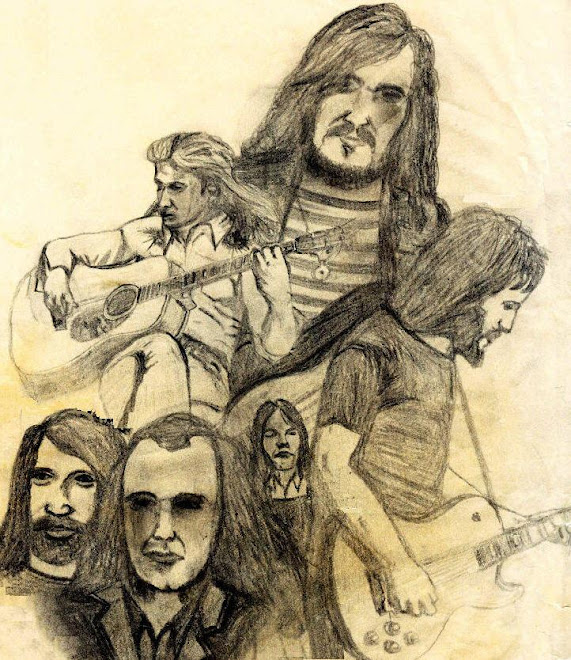
Looking at the music of Dutch rock band Focus, started in the late sixties by Thijs van Leer (b /31/03/48) with Jan Akkerman (b 24/12/46). Van Leer still performs and records under the name today (official site here). Akkerman's site here.

.

.
Showing posts with label Le Tango. Show all posts

20210604

Track by track 156 Birds come fly over

Archive number: 147
Title: Birds Come Fly Over
Main Album: The Focus Family Album
Track number: 11
Genre: Sung Ballad
Studio: Unknown
Length: 5:30
Composer: Thijs van Leer, Rosalie Peters
Musicians: Thijs van Leer piano, organ, melodics, vocals, whistling; Menno Gootjes guitars, Udo Pannekeet bass, Pierre van der Linden drums
Producer: Geert Scheigrond
Engineer: Geert Scheigrond
Label: In and Out of Focus Recordings
Date of recording/release: 2017
Other versions: This is a version of Le Tango, which has appeared in several places
Notes: Before van Leer's singing comes in at 00:53 the atmosphere is built through an instrumental section that begins with drums and acoustic guitar but is then developed with flute, organ and a chugging electric guitar. The lyrics continue through the rest of the song, with instrumental interludes of varying short lengths. The piano is prominent but the melodica is in there and the electric guitar gets a good run just before a quieter section (out of a million overs, etc) where van Leer's whistling is present, 04:02-04:44.

The lyrics
I'm always watching sunrise
I have at least a life
And for my heart's desire I can die

And you my love, my good love
I see you live your life
But in my heart I've often seen you cry

I'm only waiting for the time to pass
How can I raise my voice or my hand
Birds come fly over to the sun

Out of a million lovers
One only could be mine
But there's a million others passing by

From sun up until sundown
This life is such a strife
And if you loose your love you loose your life

I'm only waiting for the time to pass
How can I raise my voice or my hand
Birds come fly over to the sun

20191010

Track by track 131 Birds Come Fly Over (Le Tango)

Archive number: 131
Title: Birds Come Fly Over (Le Tango)
Main Album: Focus X
Track number: 6
Genre: Jazz Pop Vocal
Studio: Fieldwork Studios, Schoten, Belgium
Length: 5:21
Composer: Thijs van Leer, Roselie Peters
Musicians: Thijs van Leer – Hammond organ, piano, flute, melodica; Menno Gootjes – Guitars; Bobby Jacobs – Bass; Pierre van der Linden – Drums; Ivan Lins - vocals. 
Producer: Bobby Jacobs, Geert Scheijgrond
Label: Eastworld Recordings
Date of recording/release: November, 2012
Alternative version: The same track is on The Focus Family album. Versions of  Le Tango appear on the Focus album with Jan Akkerman, on Introspection 4 and in other places.
Notes: We begin with drums then acoustic guitar, organ, flute and eventually a chugging electric guitar in tango time. At 0:54 the vocal begins. The words are

I'm always watching sunrise,
I have at least a life
And for my heart's desire, I can die.

And you my love, my good love,
I see you live your life,
But in my heart I've often seen you cry.

I'm only waiting for the time to pass,
How can I raise my voice or my hand?
Birds come fly over to the sun.

Out of a million lovers,
One only could be mine,
Oh there's a million others passing by

From sun up until sundown
This life is such a strife
And if you lose your love you lose your life.

I'm only waiting for the time to pass,
How can I raise my voice or my hand?
Birds come fly over to the sun.

There is a brief instrumental section announced by a beat from 2:02-02:21 after verse 3. In the subsequent part van Leer's melodica is heard. From 3:28-04:01 the band comes in more strongly again before the final vocal section which features the second three verses repeated. A piano is heard in the mix this time.

20090123

Track by track 80 Le Tango

Archive number: 80
Title: Le Tango
Main Album: Focus (1985)
Track number: 3
Genre: Progressive Rock Instrumental
Studio: Studio Spitsbergen, Zuidbroek, Groningen, The Netherlands (mixed at Dureco Studios, Weesp, The Netherlands)
Length: 04' 49”
Composer: Thijs van Leer/Roselie Peters
Musicians: Jan Akkerman - Synthesiser Guitar, drum machine; Thijs van Leer – Keyboards inc piano and synthesisers; Sergio Castillio – Drum fills; Fairlight programmed by Ed Staring.
Producer: Ruud Jacobs with Jan Akkerman, Thijs van Leer and Theo Balijon
Engineer: Emile Elsen, Jan Akkerman and Theo Balijon
Label: Mercury (Phonogram)/Vertigo
Date of recording/release: Recorded 1985 Released LP/CD -1985 CD – 1989
Alternative version: van Leer has recorded this number more than once elsewhere
Notes: Van Leer has said that he heard the Polish-American pianist Arthur Rubinstein (1887-1982) saying how much he loved the tango (it is in a 1969 documentary on his life L'amour de la vie). It led van Leer to write this number with his then wife. Here, we begin with loud guitar and drums from Akkerman (00:00-00:12) but the track quickly slips into the familiar tango rhythm, provided chiefly by van Leer's piano (00:13-00:38). From 00:39 and a torpedo-like sound that occurs again at times (eg 01:03, 01:36) the two elements combine, staccato rhythm predominating over slight melody (00:40-02:38). A much faster guitar-led section follows (02:39-03:08) before returning to the previous staccato style. Not really getting anywhere the track begins to fade from about 04:30.
Note on the tango (from Wikipedia)
Tango is a musical genre and is used for its associated dance forms. It is traditionally played by a sextet, known as the orquestra typica (2 violins, piano, double bass, 2 bandoneons). Earlier forms of this ensemble sometimes included flute, clarinet and guitar. Tango music may be instrumental or include a vocalist. It is well-known across much of the world, along with the associated dance, which originated in (lower-class districts of) Buenos Aires, Argentina and Montevideo, Uruguay. Early tango was sometimes known as tango criollo.
The music derives from the fusion of various forms from Europe. Jorge Luis Borges (El idioma de los argentinos) writes:"Tango belongs to theRio de la Plata and it is the son of Uruguyan “milonga” and grandson of the “habanera”. The word Tango seems to have first been used in connection with the dance in the 1890s. The music's deep roots cannot be fully known but it is safe to assume that it is a combination of musical traditions from Spain, West Africa, Central Europe and North America, in chronological order.
Even though the present forms are 19th century, there are records of 18th and early 19th century tango styles in Cuba and Spain, while there is a flamenco tango dance that may share a common ancestor in a minuet-style European dance. All sources stress the influence of the African communities and their rhythms, while the instruments and techniques brought in by European immigrants in the second half of the 19th century played a major role in its final definition, relating it to the salon music styles.
The first tango ever recorded was made by Angel Villodo and played by the French national guard in Paris. Villoldo had to record in Paris because there was no recording studio in Argentina at the time. Early tango was played by immigrants in Buenos Aires. The first generation of tango players was called "Guardia Vieja" (the Old Guard). By the end of the 19th century, the music was heard throughout metropolitan Buenos Aires. It took time to move into wider circles. In the early 20th century it was the favourite music of gangsters who visited the brothels, in a city with 100,000 more men than women (1914). The complex dances that arose from the music reflect the habit of men practicing tango together in groups, expressing both machismo and sexual desire, leading to the form's distinct mix of sensitivity and aggression. The music was played on portable instruments (flute, guitar, violins, etc). The organito, a portable player-organ, broadened the popularity of certain songs.
Like many forms of popular music, the tango was associated with the underclass, and the better-off Argentines tried to restrict its influence. In spite of the scorn, some were fans. A poem describes the music as like the "all-absorbing love of a tyrant, jealously guarding his dominion, over women who have surrendered submissively, like obedient beasts".
The tango has attracted many musicians and has become part of the repertoire for some classical musicians. One of the first classical interpreters to "cross over" was baritone Jorge Chamine, who worked with bandoneonist Olivier Manoury. Since then, Yo-Yo Ma, Danile Barenboim, Placido Domingo, etc, have performed and recorded tangos. Among classical composers who have written tangos are Albeniz (in EspaƱa 1890), Satie (1914), Stravinsky (1918) and John Cage (1984). Many popular songs in the US have borrowed melodies from tango.