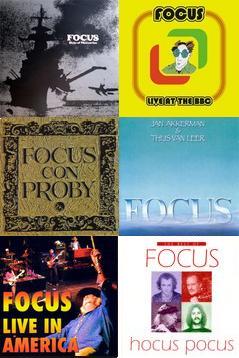
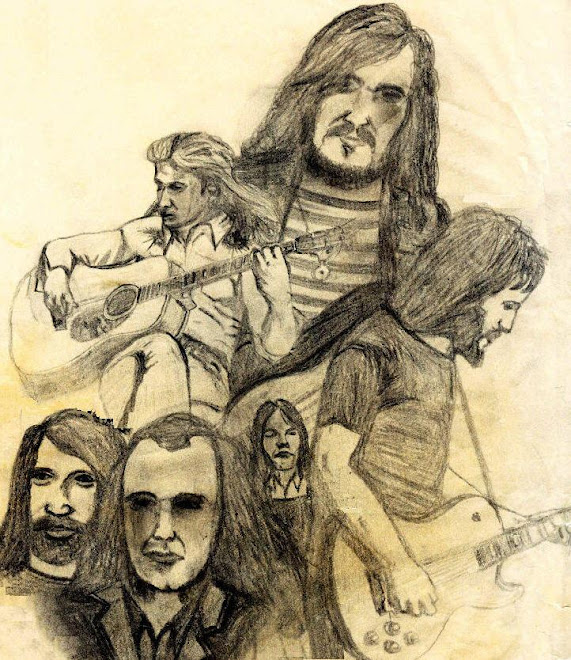
Looking at the music of Dutch rock band Focus, started in the late sixties by Thijs van Leer (b /31/03/48) with Jan Akkerman (b 24/12/46). Van Leer still performs and records under the name today (official site here). Akkerman's site here.

.

.
Showing posts with label Van Leer Cleuver. Show all posts

20071128

Track by track 8 Spoke the Lord Creator

Archive number: 8
Title: Spoke the Lord Creator
Main Album: Ship of Memories
Track number: 7
Genre: Progressive Rock Instrumental
Studio: Sound Techniques Studio, 46a Old Church Street, Chelsea, London SW3
Length: 2' 28”
Composer: Thijs van Leer, Hans Cleuver
Musicians: Jan Akkerman - Electric guitars (Fender telecasters); Thijs van Leer - Hammond organ; Martijn Dresden – Bass; Hans Cleuver – Drums
Producer: Hubert Terheggen (RTM)
Engineer: Jerry Boys
Label: LP – EMI, Harvest, Sire CD – EMI-Bovema, IRS, Red Bullet, JVC
Date of recording/release: Sunday, January 26, 1970. Abandoned and not released until 1976 (LP). CD – 1988, 1993, 2001, 2006.
Alternative version: 1971 single with vocals by Teach-in
Notes: This incomplete (?) track from the In and out of Focus sessions eventually appeared on the “cutting room floor” collection Ship of Memories in 1976. It is perhaps the earliest attempt by Focus at what later became the beginning of Hamburger Concerto, using Haydn's variations on Brahms. The opening 11 seconds of van Leer organ has a classical feel but this gives way to the main theme (00:12-01:33) which involves the whole group, Akkerman leading on a countrified electric guitar (as heard at the end of Focus 1) and leading into screaming guitar (as heard on Why Dream). From 01:34 there is a change and chopped guitar chords predominate in a section with a long fade as the piece fails to gain real momentum.
The track was eventually recorded by Teach-in in 1971 with these lyrics by Eric Cleuver:

Spoke the Lord Creator
"Hear me, I'm the Lord your Maker,
you're my creatures hear me, hear me,
stay for ever near me."
But satanic laughter sounded
and a voice said "No no no!
God is dead, the earth is yours,
live now, there's nothing later.
Go my joy behaviour,
listen, there's no judgement, Saviour"

"There is no solution,
pilgrim, take the road of evolution
but in his creation
find him in man's inspiration".
Then a child its laughter broke,
the press of human vanity,
giving hope wherever voices
cry in desperation.
Hear his voice above, pilgrim,
on your search for love."

Note on Teach-in (from Wikipedia)
Teach-In was a Dutch band, best known for winning the Eurovision Song Contest in 1975 with "Ding-a-Dong". The band was founded in 1969 and broke up in 1980. There were several line up changes. Formed in Enschede, the first line up was Hilda Felix (vocals), Henk Westendorp (vocals), John Snuverink (vocals, guitar), Frans Schaddelee (bass), leader Koos Versteeg (vocals & keys) and Rudi Nijhuis (drums). One of the first songs the group ever recorded (on CBS) was "Spoke the Lord Creator". In 1972, only Koos and Rudi remained, the rest of the band comprised Getty Kaspers (vocals, left 1976), John Gaasbeek (bass, left 1976), Chris de Wolde (guitar) and Ard Weeink (left 1976). New members in 1976 were Hans Nijland (bass, replaced by Nick de Vos 1977), Betty Vermeulen (vocals), Marianne Wolsink (vocals). In 1971 they got their first recording contract with producer and composer Eddy Ouwens (CNR records). In 1974 they had three top 15 hits, after which their Eurovision entry was recorded. They toured Europe for the next two years but success took its toll and they split up in 1978. In 1979 Ruud Nijhuis and Koos Versteeg reformed the band with two new female singers. After three more hits they split again. In 1997, news came that the original line up (with Getty Kaspers) had re-recorded some of their old hits and had plans to tour. Kaspers vocals can be heard on Rick van der Linden's Cum Laude album. The band reunited to sing "Ding-a-Dong" at a show in Maastricht in 2007.

20071127

Track by track 6 Why Dream

Archive number: 6
Title: Why dream
Main Album: In and Out of Focus (Also a single in 1970)
Track number: 6 (second on the Sire release)
Genre: Jazz Pop Vocal
Studio: Sound Techniques Studio, 46a Old Church Street, Chelsea, London SW3
Length: 3' 54"
Composer: Thijs van Leer (music) Eric Cleuver (words)
Musicians: Jan Akkerman - Electric guitars (Fender telecasters), Acoustic guitars; Thijs van Leer - Vocals, Hammond organ, Piano; Martijn Dresden – Backing vocals, Bass; Hans Cleuver – Drums
Producer: Hubert Terheggen (RTM)
Engineer: Jerry Boys
Label: LP - Imperial, Sire, Polydor; CD - EMI Bovema, IRS, Red Bullet
Date of recording/release: Late January 1970/Autumn 1970 (1973 in the US. In 1974 the album appeared in Brazil as Pop Giants). CD – 1988, 1993, 2001.
Notes: The track begins with solemn strummed acoustic guitars, 'violined' electric guitar and organ (00:00-00:14). The reverbed vocal then comes in backed by acoustic and electric guitars, organ, bass, drums and some piano. Van Leer's vocal uses the same alternating and double tracking style found on Happy Nightmare. This vocal section takes up the bulk of the track (00:15-02:23). At 02:24 an instrumental section is dominated by Akkerman's echoing and horn-like electric guitars against acoustic guitars, organ and the rhythm section. For the only time on the album, the song ends with a fade.
The lyrics by Hans Cleuver's father are

“Why dream about the future?
Now is the present, as bad as the present can be.

Why dream about the future?
The light is dark, and darkness is all you can see.
 
Planes go flight by flight (Planes go flight by flight)
Ready for a fight (Ready for a fight)
Ships pass in the night (Ships pass) through the Bosphorus

Marching columns sound (Marching columns)
Reasons scattered, found
For me, for you
For all of us.

Why dream about the future?
The sun is shining upon a world full of fear.
Why dream about the future?
When the clash and the bang of that future is coming too near.

This is our time (This is our time)
We will drink this wine (We will drink this wine)
Reaches our cup (Reaches) And we like it fine.

Please don't hesitate
Before it is too late,
You had your chance and lived your fate.
 
We dream about the future!
Where we can change things as they ought to be.
 
We dream about the future!
Where we'll be moulding and choosing our own destiny.”

Peet Johnson suggest that the lyrics reflect the times. The reference to the Bosporus relates to the Soviet shipment of military supplies from Nikolayev in Ukraine to Hai Phong, North Vietnam via those Turkish straits.
Note on Fade (based on Wikipedia)
This is the first of a limited number of Focus tracks that fade out rather than coming to a definite conclusion. A recorded song can easily be gradually reduced to silence at its end (fade-out). A gradual increase from silence at the beginning (fade-in) can also be used. The length of fade can vary. Fading-out can serve as a recording solution for pieces of music that contain no obvious ending.
"Neptune", from orchestral suite The Planets by Gustav Holst is said to be the first piece of music to end with a fade-out. Though commonplace today, the effect bewitched audiences in the era before widespread recorded sound (1918).
The technique of ending a spoken or musical recording by fading out the sound goes back to the earliest days of recording. In the era of pre-electrical recording, this could only be achieved by either moving the sound source away from the recording horn or by gradually reducing the volume at which performers sang, played or spoke. With the advent of electrical recording, smooth and controllable fadeout effects could be easily achieved by simply reducing the input volume from the microphones using the fader on the mixing desk. No single recording can be reliably identified as "the first" to use the technique.

20071121

Track by track 2 Black Beauty

Archive number: 2
Title: Black Beauty
Main Album: In and Out of Focus (was Focus Plays Focus) Also a single in 1970 and 1971
Track number: 2 (fifth on Sire release)
Genre: Jazz Pop Vocal
Studio: Sound Techniques Studio, 46a Old Church Street, Chelsea, London SW3
Length: 3' 08"
Composer(s): Thijs van Leer (music) Erik Cleuver (words)
Musicians: Jan Akkerman - Electric guitar (Fender telecaster), acoustic guitars; Thijs van Leer - Vocals, Piano; Martijn Dresden – Bass, Trumpet; Hans Cleuver – Drums
Producer: Hubert Terheggen (RTM)
Engineer: Jerry Boys
Label: LP - Imperial, Sire, Polydor; CD - EMI Bovema, IRS, Red Bullet
Date of recording/release: Late January 1970/Autumn 1970 (1973 in the US. In 1974 the album appeared in Brazil as Pop Giants). CD – 1988, 1993, 2001.
Alternative version: An instrumental version was recorded much later and is on Focus 9.
Notes: The track begins with five successive screaming notes from the electric guitar spaced out over the opening 20 seconds with heavy drums, heavy but rhythmic bass then heavy drums again. The rhythm section are joined by an acoustic guitar and the vocal comes in at 00:21. Accompanied by guitars and piano, it goes on to 01:58 when there is an instrumental break featuring the electric guitar screams again and a partly muted trumpet (1:59-02:20). The band backed vocal then proceeds to the end via a key change (02:21-03:08). The number is again basically recorded live with perhaps some of the piano (used with the lyrics marked below in italics) and the electric guitar that appears at various points overdubbed as well as reverbed vocals and the trumpet. The lyrics have a rather eastern feel, which is reflected a little in the music. They contain a reference to the legend of King Solomon's affair with the Queen of Sheba. (Their meeting is recorded in Scripture but the love affair is pure legend). It has been suggested that the topic is an inter-racial liaison, a controversial matter in many places at that time. The lyrics are

“Night was stark, your skin was dark,
Your eyes were shining bright,
Oh black beauty, close in my heart.
I was King Solomon who held his Queen of Sheba tight,
Oh black beauty, held in my arms.

How we were told
Love was not meant for us,
Two diff'rent worlds kept apart,
Heart against heart.

But we knew where to find an opportunity,
Far away where no one was near.
We could meet there at night and with impunity,
Oh black beauty, love without fear.

Our love was wonderment,
So young and so pure.
I held your trembling hands,
I was so sure.


Then when our lips met
There was no returning,
The fire was burning
In our hearts.

(Break)

So we were told
Love was not meant for us,
Two different worlds kept apart,
Heart against heart.

But we knew where to find an opportunity,
Far away where no one was near.
I was King Solomon who held his Queen of Sheba tight,
Oh black beauty, love without fear.”

Peet Johnson tells us that an alternative set of lyrics called Questions was prepared by Mike Hayes but not used. They are re-produced in his book.
A note on the Queen of Sheba (from Wikipedia)
The Queen of Sheba (Malkat Shva) refers in Ethiopian history, the Old and New Testaments and the Qur'an to the woman who was ruler of the ancient kingdom of Sheba. The location of the historical kingdom may have included both Ethiopia and Yemen. Known to the Ethiopians as Makeda this queen has been called a variety of names by different peoples in different times. To King Solomon of Israel she was the Queen of Sheba. In Islamic tradition she was Bilqis. Roman historian Josephus calls her, Nicaula. She is thought to have lived in the 10th Century BC. Taking into account Genesis 10 many scholars see the Queen of Sheba as a descendant of the Semitic Sheba people located in southern Arabia but with origins in Ethiopia.
According to the Hebrew Bible, the unnamed queen of the land of Sheba heard of the great wisdom of Solomon and journeyed there with gifts of spices, gold, precious stones and beautiful wood and to test him with questions (1 Kings 10:1-13, 2 Chronicles 9:1-12). It is related further that the queen was awed by Solomon's great wisdom and wealth and pronounced a blessing on his deity the LORD. Solomon reciprocated with gifts and "everything she desired," whereupon the queen returned to her country. The queen was apparently quite rich, however, as she brought 4.5 tons of gold with her to give to Solomon (1 Kings 10:10). In the biblical passages which refer explicitly to the Queen of Sheba there is no hint of love or sexual attraction between Solomon and the Queen of Sheba. The two are depicted merely as fellow monarchs engaged in the affairs of state. The biblical text Song of Songs contains references, which at various times have been interpreted as referring to love between Solomon and the Queen of Sheba (but with no real warrant - there is little to identify the speaker in the text with the rich and powerful foreign queen depicted in Kings). It is the later Ethiopian tradition that Cleuver's lyrics reflect. This firmly asserts that Solomon seduced and impregnated his guest and provides a detailed story of how he went about it. The matter is of considerable importance to Ethiopians - as their emperors traced their lineage to that union.

20071120

Track by track 1 Focus (vocal)

Archive number: 1*
Title: Focus (vocal)
Main Album: In and Out of Focus (previously known as Focus Plays Focus)
Track number: 1 (sixth and final track on Sire release)
Genre: Jazz Pop Vocal
Studio: Sound Techniques Studio, 46a Old Church Street, Chelsea, London SW3
Length: 2' 43"
Composer(s): Thijs van Leer (music) Erik Cleuver (words)
Musicians: Jan Akkerman - Electric guitar (Fender telecaster); Thijs van Leer - Vocals, Hammond organ; Martijn Dresden – Bass; Hans Cleuver – Drums
Producer: Hubert Terheggen (RTM)
Engineer: Jerry Boys
Label: LP - Imperial, Sire, Polydor; CD - EMI Bovema, IRS, Red Bullet
Date of recording/release: Late January 1970/Autumn 1970 (1973 in the US. In 1974 the album appeared in Brazil as Pop Giants). Also 1971. CD – 1988, 1993, 2001.
Alternative version: A longer instrumental version appears elsewhere on the album and in rearranged form on van Leer's first Introspection album.
Notes: This track, which still features in the act today, is the first of a series bearing the eponymous title Focus and the only one of those to boast a vocal (although only 10 words at that). The same tune features as an instrumental elsewhere on the album. One of the earliest originals the band played, it is notable for Akkerman's pioneering use of volume swell or 'violining' without a pedal. The sound itself is very much a sixties rather than a seventies one. The number is basically recorded live with echo or reverb, especially on the vocal.
The band (bass, organ, drums) begin together setting up a slow jazz style rhythm (00:00-00:11) over which first van Leer tentatively sings (00:12-00:36) then Akkerman does his stuff, the track ending with just the guitar and eight hits of the cymbal, four slow and four quick.
Although Focus became primarily an instrumental band, the first album is about half and half vocals and instrumentals and every album has vocals on it somewhere.
The words act as a sort of manifesto for the band. They are

"Focus yourself on the love
You owe mankind.
Communication again."

We are still only three years on from the "summer of love" and such sentiments were in the air. The track can drag a little perhaps and was probably not the best choice for an opener, as is reflected in its postponement to the end of the American release. On the other hand, as originally conceived, the second track comes with some impact after this laid back opener.

*It is true that the original Focus line-up appeared on record together before this track was released (for the Dutch version of Hair, on Ramses Shaffy's album Sunset Sunkiss and on certain tracks for the album The Beauty of Bojoura but this is the first time they appeared on record together and alone as Focus).
It has been suggested that there was a previous recording of the first album in Amsterdam before the London version we have today. Apparently this is not so.