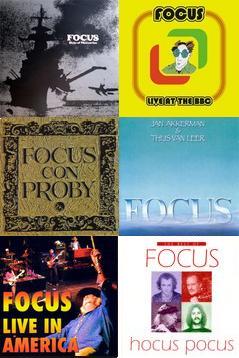
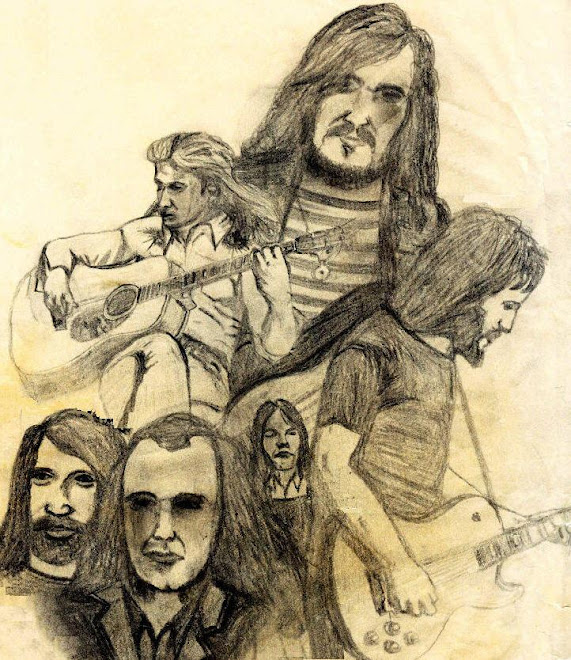
Looking at the music of Dutch rock band Focus, started in the late sixties by Thijs van Leer (b /31/03/48) with Jan Akkerman (b 24/12/46). Van Leer still performs and records under the name today (official site here). Akkerman's site here.

.

.
Showing posts with label Sitar. Show all posts

20090615

Focus Live 06

A good number of recordings have surfaced from the very busy period that the second half of 1973 was, some of them quite interesting.
Focus were supposed to begin touring America and Canada in early July 1973 but Van Leer went down with appendicitis and so the tour was delayed. They did do San Francisco (Friday June 29) and Passaic NJ (Friday July 13). Eventually they did over 20 more dates in the period October 30-December 1. While in America Akkerman hired an electric sitar, which he also used on his solo album Tabernakel recorded in between gigs in New York, July 14-25.
The sitar can be heard on Anonymous 2 in a gig recorded at the Hollywood Sportatorium in Hollywood, Florida on August 25. Either side of Anonymous 2 they play Focus 3/AQQA/Focus 2 and Hocus Pocus/Sylvia/House of the King/Hocus Pocus (reprise). That same month Focus also played back in Holland, in de Veermarkthallen in Leeuwarden. In this concert Anonymous 2 does not appear but a long version of Eruption does and this features not just the electric sitar but Akkerman playing the recently composed Hamburger Concerto riff on it.
Recordings exist from some time in Arlington, University of Texas, where Van Leer distinguished himself with quite an amazing operatic riff. In late September the band were in Europe, appearing at Alkmaar in Holland (Friday September 14) and the Turnhout Festival in Belgium (with Kayak, etc) on Sunday September 30. Rehearsals then began in Kasteel Groengueid, Holland for Hamburger Concerto. It is at this time that Van Der Linden left the band to be replaced by Colin Allen, who played his first gig with them in Toronto on October 29. This gig is notable for the first version of Hamburger Concerto, a 27:11 work out complete with drum break. They also played Focus 1 and the Rainbow material on this occasion.
On Friday November 2 they were in Bloomington, Indiana. It is during this concert that Van Leer mistakenly announced Pierre Van Der Linden on the drums and has to apologise and correct himself. A classic moment!

20090219

Jan Akkerman: the eastern element


In an interview in Odessa, Ukraine, in 2005 Jan Akkerman said “I think I have Russian roots. My aunt told me that one of my great-grandmothers was from the Akkerman region (a nearby fortress does have the name Akkerman) where were then living the Dutch merchantmen who traded between South Russia and Holland. My last name seems to be very eloquent in this respect, though sometimes I think I can't be completely certain in that. All in all, I don't have a wish to delve into my genealogy, but I believe my ancestors were from here.” No doubt he was not wholly serious but if you listen to Akkerman's music you will see that there is something in what he says. Eastern music is notoriously difficult to define but something definitely happens to harmony and rhythm east of a point somewhere in line with Vienna that is quite distinct. This eastern element can be found in several places throughout Akkerman's work. In recent years Akkerman and his band have played live in Mumbai, in Japan, in the middle east and other places east of Vienna and he has sometimes deliberately brought out this eastern element in these places. The current very eastern version of
House of the King (Palace of the King) typifies it. If truth be told, however, House of the King always did have something eastern about it, something first declared unequivocally in the electric sitar version found on the solo album Tabernakel. Like many others in the UK my first introduction to Akkerman's music was the album Moving Waves with Focus. One feature of that album was its unique sound. It was quite different to much of the rock music around at the time. Its European sound was often referred to. However, not only did it sound pretty European but in certain places there was an undoubtedly eastern feel to it. Think of a track like Janis for example, with its distinctly eastern flutes or certain parts of the long track Eruption, especially Dayglow. Hocus Pocus and the title track also share this eastern feel. (Vanessa Mae's version of Hocus Pocus brings out the eastern element very well). This was the early seventies, of course. The Beatles and others had already blazed a trail to India and back so this element was a very contemporary one. Jan appears on the original cover, if you remember, wearing a state of the art khaftan. A similar phenomenon is faintly recognisable on the first and third Focus albums (although to be fair, both albums contain tracks firmly in the Caribbean tradition and so no corner of the globe is entirely neglected). Check out Black Beauty or Love Remembered for example. Harem Scarem and parts of Hamburger Concerto (especially Medium 1) also contain quite eastern elements. Akkerman's eastern credentials go back a long way. His art was cradled in the very beginnings of Dutch rock in the fifties, when the Tielman brothers from Indonesia and their Indo-rock style dominated the Dutch scene. In a recent interview Akkerman has said that there were “a lot of Indonesian kids in the area where I grew up, and we played blues and rock & roll”. That surf rock sound always did have an eastern leaning and the influence can be detected in the early music of Akkerman and others. (The eastern influence on Dick Dale for example is widely acknowledged). Akkerman also admits freely to other early eastern influences from gypsies and from Balkan music. Before his Focus days the eastern element can also be detected in the Jewish traditional, Hineimatov, on the first solo album, on the Russian styled hits with The Hunters The Russian spy and I and Janosh (revisited on Russian Roulette with Van Leer in 1985) and quite obviously on the Brainbox track Dark Rose. By the time we come to the solo album Tabernakel Akkerman is featuring, at certain points, both the electric and the acoustic sitar. For some reason the sitars are not credited on the original album but it is an open secret that in the seventies and eighties Jan often used a Coral electronic sitar. This sitar also apparently features on the later Focus track Glider (on Ship of Memories). Jan also played it in public at the end of 1974 at a Brainbox reunion concert, later shown on Dutch television. With regard to the early solo albums Profile and Tabernakel, it is interesting that Akkerman plays the oudh-like lute rather than, say, a banjo! In the seventies Akkerman played and recorded a lot with Neppie Noya the Indonesian born percussionist and son of Japanese Taiko drummer Fusao Nakato San. Later on, the legendary 1981 album Oil in the family features a very eastern style cover, reflecting the strong presence of eastern style melodies on most tracks. Jan actually credits A. Rab (!) as composer on certain tracks in an effort to acknowledge his borrowings from unknown middle-eastern musicians. Some live performances of this material actually featured the use of a belly dancer. The album apparently went down very well in Turkey. With subsequent albums the eastern element is perhaps excluded, though in 1985 on the track Indian Summer with Thijs Van Leer an Indian tabla player based in Holland (Ustad Zamir Ahmad Khan) is brought in and some have detected it, for example, on some of the percussion for The noise of art (1990), the track Saudade on Focus in time (1996) and the opening track See you! on CU (2003). How much direct Akkerman influence there may be in the Forcefield tracks Year of the Dragon and Tokyo (on their second and third albums of 1988 and 1989) we do not know. The more one is aware of this eastern element, however, the more one can hear it perhaps.

20080607

Track by track 58 My Sweetheart

Archive number: 58
Title: My Sweetheart
Main Album: Mother Focus
Track number: 11
Genre: Funky Pop Instrumental
Studio: Decca Studios, Hollywood, Los Angeles, California (later Studio 55)
Length: 3' 28”
Composer: Thijs van Leer, Jan Akkerman
Musicians: Jan Akkerman - Electric sitars; Thijs van Leer – Piano, Mellotron, Flute; Bert Ruiter – Bass; David Kemper – Drums, Congas
Producer: Hubert Terheggen/Focus
Engineer: Eric Prestidge
Label: LP – Polydor, Atco, Philips, EMI Date of recording/release: Recorded 1975, released October 1975. LP – 1975, 1977, CD - 1988
Alternative version: Van Leer repeated this track on his solo album Nice to have met you.
Notes: This bass driven piece of disco-influenced pop music begins with the whole band grooving (00:00-00:15) before the electric sitar strikes out a melody (00:16-02:04). It is the sitar that carries the load for most of the time though the flute (possibly synthesised at first) can also be heard in the background (01:17-01:33). A flute-led bridge then takes us on (02:05-02:16) until the sitar leads again (02:17-02:30). The flute is heard again (02:31-02:43) and things break down (02:44-02:49) until a bass-led break (02:50-03:07) some more flute (03:08-03:20) and a fade (03:21-03:28).