.

Showing posts with label La Cathedrale de Strasbourg. Show all posts
Showing posts with label La Cathedrale de Strasbourg. Show all posts
20121112

20101021
Focus live @ Jazz Cafe 2010
These clips show Focus at a recent gig in the Jazz Cafe, London. This was the last gig of the tour. Unusually, the guitarist is Menno Gootjes, the regular guitarist having had to drop out. Here we have House of the King followed by bit of flute and scat from Thijs, a little Cathedrale and the repeated Sylvia finale. Thanks guys! Menno has subsequently become the regular guitarist.
20090407
Track by track 93 Cathedrale de Stasburg (Live FLIA)
Archive number: 93
Title: Cathedrale de Strasbourg (Live)
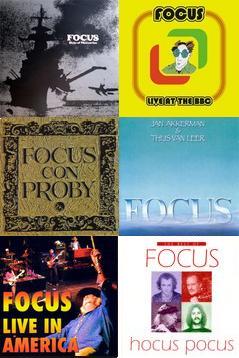
Main Album: Focus Live In America
Track number: 7
Genre: Progressive Rock Vocal
Venue: Patriots Theater, 1 Memorial Drive, Trenton, New Jersey, USA
Length: 12' 57”
Composer: Thijs van Leer
Musicians: Thijs van Leer – Hammond organ, Vocals, Whistling; Jan Dumee – Gibson Marauder Guitar; Bobby Jacobs - Bass; Bert Smaak - Drums
Producer: Gavin Bott/Bob Carruthers
Engineer: Mike Potter (Orion Sound) Mix (Total audio)
Label: Classical Rock Legends Limited
Date of recording/release: October 2002 (part of a two day Uriah Heep led classic rock legend festival that also featured Nektar, Mostly Autumn and Asia). Released on DVD and CD (edited) in 2003.
Alternative version: This track originally appeared on the Hamburger Concerto album
Notes: The data about this track is found on the previous track - “We've got another slow song for you. It's like a nostalgic feel I had thinking of the bells of the Cathedral of Stratzburg, which is a town in France on the frontiers with Germany and those bells had a very, very beautiful sound and I was a very little boy and I was more than impressed. So here's the impression. It's a little lyric sung in French.” The track itself begins with bell like organ tones. The band then join in. It was once unusual for this track to be played live and so again makes it easier for Dumee who plays well. Van Leer does slightly better with the vocals this time, the style suiting him better. He whistles well too (also in French!) as on the original (02:25-04:00). His voice is also heard near the end (05:38-06:10). The track closes (06:22) with the sound of the audience and van Leer's thanks. The CD then has the words “we go to a number which we call Focus number 7” Harem Scarem being edited out of the CD version. On the DVD he says “Here's a song I wrote in the pub in Belgium. It's called Harem Scarem."
20081202
Place Titles
 Places specific or not are sometimes mentioned in Focus titles.
 Specific
La Cathedrale de Strasbourg
Sugar Island (Cuba)
Vesuvius (See Out of Vesuvius on Ship of Memories)
Rio in Brazil (See Rock and Rio and Brazil Love)
Heaven
Mare Nostrum
Non-specific
House of the King
Endless Road
The Bridge
Crossroads
As of 2024 add Positano
Non-English Titles
Focus song titles are usually in English. These are the exceptions:
French
La Cathedrale de Strasburg (Strasbourg Cathedral)
Le Clochard (The Tramp)
Spanish
De Ti O De Mi (From you or from me)
Croatian
Sto Ces Raditi Ostatac Zivota (Do everything to survive in life)
Blizu Tebe (Close to you)
Dutch
Avondrood (Red evening)
French
La Cathedrale de Strasburg (Strasbourg Cathedral)
Le Clochard (The Tramp)
Spanish
De Ti O De Mi (From you or from me)
Croatian
Sto Ces Raditi Ostatac Zivota (Do everything to survive in life)
Blizu Tebe (Close to you)
Dutch
Avondrood (Red evening)
Latin
Delitae Musicae (Delightful music)
We could add too - Anonymus (Anonymous)
20080409
Track by track 41 La Cathedrale de Strasbourg
Archive number: 41
Title: La Cathedrale de Strasbourg
Main Album: Hamburger Concerto
Track number: 3
Genre: Jazz Rock Instrumental/Vocal
Studio: Olympic Studios 'B', 117 Church Road, Barnes, London SW13 9HL
Length: 4' 56”
Composer: Van Leer
Musicians: Jan Akkerman – Electric Guitars (Fenders); Thijs van Leer – Church organ (St Mary, Barnes), Grand piano, Electric piano, Vocal, Voice; Bert Ruiter- Bass, Autoharp; Colin Allen – Drums
Producer: Mike Vernon
Engineer: Bob Hall with David Hamilton-Smith and Rod Thear
Label: Polydor, Atco, EMI, Red Bullet, JVC, JVC Victor
Date of recording/release: January/March 1974; April 1974. CD – 1998, 2001, 2001, 2002, 2006
Title: La Cathedrale de Strasbourg
Main Album: Hamburger Concerto
Track number: 3
Genre: Jazz Rock Instrumental/Vocal
Studio: Olympic Studios 'B', 117 Church Road, Barnes, London SW13 9HL
Length: 4' 56”
Composer: Van Leer
Musicians: Jan Akkerman – Electric Guitars (Fenders); Thijs van Leer – Church organ (St Mary, Barnes), Grand piano, Electric piano, Vocal, Voice; Bert Ruiter- Bass, Autoharp; Colin Allen – Drums
Producer: Mike Vernon
Engineer: Bob Hall with David Hamilton-Smith and Rod Thear
Label: Polydor, Atco, EMI, Red Bullet, JVC, JVC Victor
Date of recording/release: January/March 1974; April 1974. CD – 1998, 2001, 2001, 2002, 2006
Alternative version: Van Leer still performs this one live. He also recorded it with the Gerald Brown Singers on his solo album Reflections.
Notes: Van Leer had moved to Belgium by the time the Hamburger Concerto album was being prepared and here again we have a track with a French feel. This one was inspired by camping holidays in France as a boy and may have been part composed back then. The track has four parts. First, an instrumental introduction (00:00-02:09). This begins with reverbed solo grand piano (00:00-00:34), later intermingled with a very smooth jazz guitar (00:35-00:49). A distinctive percussive note is heard at 00:44 and may be in the background elsewhere (the autoharp?). The church organ comes in next (00:50-01:20) with the piano, then the smooth guitar too (01:21-01:54). This first section closes with solo piano and the 'ding dong' part (01:55-02:09).
Second comes van Leer's multi-tracked (three part harmony) vocal and whistling (02:10-02:34/02:35-03:05) over languorous drums and bass. The minimalist lyrics are 'La Cathedrale de Strasbourg, ding dong, ding dong, La nostalgie, se réveille' (Strasbourg Cathedral, ding dong, ding dong, The memory, one dreams).
Thirdly, Akkerman dabbles with the theme on a beautifully laid back jazz guitar over electric piano, bass and drums (03:06-04:12).
In the final section guitar and piano are joined by a choir of multi-tracked voices to sing the piece out (04:13-04:43). The whole thing ends with two piano chords then two plucked guitar notes (04:44-51). There is also a quieter final 'Amen' (04:53-04:55) at the very end.
A note on Strassbourg Cathedral (from Wikipedia)
Strasbourg Cathedral (Cathedral of Our Lady of Strasbourg) is a RC Cathedral in France. Though considerable parts are in Romanesque architecture, it is widely considered to be among the finest examples of high or late Gothic. Erwin von Steinbech is credited for major contributions 1277-1318. At 142 m, it was the world's tallest building 1625-1874 and remained the tallest church in the world until 1880. Today it is the fourth tallest church. This "gigantic and delicate marvel" (V Hugo) is visible far across the plains of Alsace and can be seen from very far off.
Construction (1176–1439) began with the quire and north transept in Romanesque style. In 1225 a team from Chartres revolutionised the construction by contributing a Gothic style. In order to find money to finish the nave, the Church resorted to indulgences. The money was kept by the Oeuvre Notre-Dame, which also hired architects and stone workers. Sandstone from the Vosges gives the Cathedral its pink hue.
Construction (1176–1439) began with the quire and north transept in Romanesque style. In 1225 a team from Chartres revolutionised the construction by contributing a Gothic style. In order to find money to finish the nave, the Church resorted to indulgences. The money was kept by the Oeuvre Notre-Dame, which also hired architects and stone workers. Sandstone from the Vosges gives the Cathedral its pink hue.
Like the city, the cathedral connects Munster-German and French cultural influences, while the eastern structures, eg the choir and south portal, still have very Romanesque features. Above all, the famous west front, decorated with thousands of figures, is a masterpiece of the era. The tower is one of the first to rely substantially on craftsmanship, with the final appearance being one with a high degree of linearity captured in stone. While previous façades were certainly drawn prior to construction, Strasbourg has one of the earliest whose construction is inconceivable without prior drawing. Strasbourg and Cologne together represent some of the earliest uses of architectural drawing. The work of Professor Bork of Iowa suggests that the Strasbourg facade's design, while seeming almost random in its complexity, can be constructed using a series of rotated octagons.
The north tower, completed 1439, was the world's tallest 1625-1874. The planned south tower was never built and as a result, with its characteristic asymmetrical form, the cathedral is now Alsace's premier landmark. One can see 30 kms from the observation level, which provides a view of the Rhine banks from the Vosges all the way to the Black Forest. During WWII, stained glass was removed and stored in a salt mine near Heilbron, Germany. After the war, it was returned by the US military.
In the 1520s the city, under the spiritual guidance of Martin Bucer embraced the teachings of Luther, whose adherents established a Gymnasium, made into a University the following century. The city first followed the Tetrapolitan Confession, then the Augsburg. Protestant iconoclasm caused much destruction to churches and cloisters. Strasbourg was a centre of humanist scholarship and early book-printing in the Holy Roman Empire and its intellectual and political influence contributed much to the establishment of Protestantism as an accepted denomination in southwest Germany (Calvin had spent several years as a political refugee in the city).
The north tower, completed 1439, was the world's tallest 1625-1874. The planned south tower was never built and as a result, with its characteristic asymmetrical form, the cathedral is now Alsace's premier landmark. One can see 30 kms from the observation level, which provides a view of the Rhine banks from the Vosges all the way to the Black Forest. During WWII, stained glass was removed and stored in a salt mine near Heilbron, Germany. After the war, it was returned by the US military.
In the 1520s the city, under the spiritual guidance of Martin Bucer embraced the teachings of Luther, whose adherents established a Gymnasium, made into a University the following century. The city first followed the Tetrapolitan Confession, then the Augsburg. Protestant iconoclasm caused much destruction to churches and cloisters. Strasbourg was a centre of humanist scholarship and early book-printing in the Holy Roman Empire and its intellectual and political influence contributed much to the establishment of Protestantism as an accepted denomination in southwest Germany (Calvin had spent several years as a political refugee in the city).
Subscribe to:
Posts (Atom)