.

Showing posts with label Mother Focus. Show all posts
Showing posts with label Mother Focus. Show all posts
20130326

20130319
20090805
Focus Live 08
By 1975 things in the Focus camp were beginning to unravel but they continued to play together. The final Akkerman era album, Mother Focus, was recorded in Belgium early in the year with David Kemper as drummer. In late June the band appeared at the Roskilde Festival in Denmark. There seems to have been other activity in Scandinavia that year, including a disastrous stadium concert in Oslo, but none of it is available in recorded form.
At some point Pierre Van Der Linden rejoined the band for their return visit to Australia and Japan in June. Again the Japanese were ready with recording devices and shows in Osaka and Tokyo have been preserved. The one in Osaka on Thursday June 19 features part of AQQA/Focus 2 (presumably they began with Focus 3 or an improvisation, as in Tokyo), then comes Sylvia and House of the King and a new piece that never made it to a studio recording (some detect lines from Crackers and Can't Believe My Eyes in it). It was also played in the Budokan Hall, Tokyo on July 2. In Osaka we then have the end of Hamburger Concerto, a flute solo and most of a version of Eruption. The Budokan Hall concert begins with an improvisation that leads into AQQA/Focus 2. We then have the untitled track, the very end of Hamburger Concerto, House of the King and Sylvia. Both concerts close with Hocus Pocus, an improvisation (partly lost on the Osaka version) with Eurydice from Eruption and Hocus Pocus (reprise). Recordings also exist from Tokyo in 1975 of a 24 minute Eruption and a 10 minute Hocus Pocus. The lack of Mother Focus material seems strange but was may be due to working with Van Der Linden.
That year three concerts were performed in Spain (February 4-7) and at least two in Denmark.
20090224
Van Leer: the humorous element
 One thing that attracted me to Focus’s music as a teenager in the 1970s was its seriousness. Raised on pop music I was tiring of its superficial predictability. Then along came Focus with something quite different. The irony is that if the novelty piece Hocus Pocus had not become an international hit, I may never have discovered Van Leer (and Akkerman's) music. Somewhat unique in being the only yodelling track to consistently feature on albums that showcase the world’s greatest guitarists, it manages somehow, with its claps, shouts, whistles, yodels and blistering guitar riffs both to amuse and amaze. Perhaps the live version on Focus at the Rainbow is the most fun. (On the 1973 American tour, one night poor old Van Leer sang ‘And on the drums Pierre van der Linden’ only to find Colin Allen there – a reminder that not all humour is intentional!)
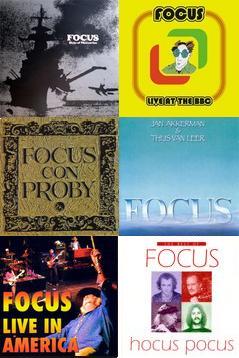
On Focus Con Proby the question is asked When does a smile begin? There is certainly a vein of humour, especially in Akkerman's work but also in Van Leer's that surfaces at various points. It is certainly in the Focus output and perhaps the search for novelty did dog them. Singles Harem Scarem and Mother Focus tried to capitalise on Van Leer’s distinctive vocals but nothing is quite as much fun or as satisfying as yodelling! An earlier version of Mother Focus is preserved on Ship of Memories, of course, in the weirder, possibly more satisfying, guise of Glider.
Round goes the gossip (the opener on Focus 3) is a track of subtle humour, weirdly enunciated Latin amid a jazz set overlaid with eventually manic voices repeating the title. Both Carnival Fugue and Elspeth of Nottingham (with its cow mooing at the end) are not without humour either. At the end of the second side of what was originally a double album one can appropriately hear weird and manic laughing in the distance. Eruption (Moving Waves) with its call and answer, piano forte style and monastic choir is another track with witty moments. However, in the musical gag department perhaps Hamburger Concerto (Rare, Medium and Well done!), whose very title is a rather old joke, is the most eccentric. It features Van Leer alternately singing male and female opera parts along with an old Dutch hymn sung in a perfectly composed manner amid classical piano and timpani, electric jazz and rock.
Van Leer's solo output and later Focus work is not marked to any great extent by this same sort of humorous approach though it does surface on rare occasions. For example – Super Fishel and Bahama Mama on Nice to have met you with its rather humorous cover (compare the more risque joke on the best of collection Collage) and perhaps I hate myself (for loving you) on the album of that name and Shock treatment on the same album plus Hurkey Turkey Parts 1 and 2 and the rather weird Flower shower (Focus 8 bonus track) - what on earth is going on there? - and possibly European (Rap)sody. Other fun tracks include Finale (Glorious album), the Rondo pieces and several others. Often when doing scat (as on Etudes sans Genes) Van Leer can be very humorous. The name 147 bars (Etudes sans Genes) is a rare example of a humorous enough title. Van Leer, unlike Akkerman, tends not to go in for such things. An example from Focus days would be using the title Anonymus on the first album or the later Mother Focus (no comment) which also includes the closing track Father Bach.
Writing about humour is seldom funny, but like other elements pinpointed in previous articles, humour is an important element in Van Leer's music to some extent and a further part of what makes his body of work the phenomenon it is.
20090219
Focus fades
The fade is used by Focus quite sparingly, except on Mother Focus, where nearly half the tracks fade. It is usually adopted where a live piece has no obvious ending. Tracks using a fade include these
1. Why dream (In and out)
2. Round goes the gossip, Carnival fugue and Sylvia (Focus 3)
3. The US or fast version of Hocus Pocus
4. Early Birth
5. Red sky at night
6. Bennie Helder, My Sweetheart, All together ... Oh that!, Hard Vanilla and No Hang Ups (Mother Focus) 7. Nightflight and Wingless (Focus Con Proby)
8. Le Tango, Who's calling and Beethoven's Revenge (Focus 1985)
9. Fretless love, Hurkey Turkey, De ti O de mi (Focus 8)
10. Father Bacchus, Hoeratio and Crossroads (Focus X)
11. Five fourth (Focus Family Album)
20081202
Family Titles

In the Focus titles family we have
Mother Focus
Father Bach
Brother
Little Sister
Sylvia's Stepson
They have all come to Birth
20080713

20080607
Track by track 59 Father Bach
Archive number: 59
Title: Father Bach
Title: Father Bach
Main Album: Mother Focus
Track number: 12
Genre: Progressive Rock Instrumental
Studio: Decca Studios, Hollywood, Los Angeles, California (later Studio 55)
Length: 1' 32”
Composer: J S Bach arranged Van Leer
Musicians: Jan Akkerman - Electric guitars; Thijs Van Leer – Hammond organ; Bert Ruiter – Bass
Producer: Hubert Terheggen/Focus
Engineer: Eric Prestidge
Label: LP – Polydor, Atco, Philips, EMI
Date of recording/release: Recorded 1975, released October 1975. LP – 1975, 1977, CD – 1988
Notes: The title is a nice joke here as it not only balances the track Mother Focus but also acknowledges the debt to the master Focus owe. Van Leer's organ, Akkerman's mostly 'violined' guitar and Ruiter's bass run through a short piece from the opening chorale of J S Bach's St Matthew Passion of 1729 (BWV 244). Van Leer turns to the piece more than once on his Introspection albums.
Track number: 12
Genre: Progressive Rock Instrumental
Studio: Decca Studios, Hollywood, Los Angeles, California (later Studio 55)
Length: 1' 32”
Composer: J S Bach arranged Van Leer
Musicians: Jan Akkerman - Electric guitars; Thijs Van Leer – Hammond organ; Bert Ruiter – Bass
Producer: Hubert Terheggen/Focus
Engineer: Eric Prestidge
Label: LP – Polydor, Atco, Philips, EMI
Date of recording/release: Recorded 1975, released October 1975. LP – 1975, 1977, CD – 1988
Notes: The title is a nice joke here as it not only balances the track Mother Focus but also acknowledges the debt to the master Focus owe. Van Leer's organ, Akkerman's mostly 'violined' guitar and Ruiter's bass run through a short piece from the opening chorale of J S Bach's St Matthew Passion of 1729 (BWV 244). Van Leer turns to the piece more than once on his Introspection albums.
A note on the St Matthew passion by J S Bach (from Wikipedia)
J S Bach (185-1750) was a German composer and organist whose sacred and secular works for choir, orchestra and solo instruments drew together the strands of the Baroque period and brought it to its ultimate maturity. Although he introduced no new forms, he enriched the prevailing German style with a robust contrapuntal technique, an unrivalled control of harmonic and motivic organisation in composition for diverse musical forces, and the adaptation of rhythms and textures from abroad, particularly Italy and France. Revered for their intellectual depth and technical and artistic beauty, Bach's works are many. While his fame as an organist was great during his lifetime, he was not particularly well-known as a composer. His adherence to Baroque forms and contrapuntal style was considered "old-fashioned" by his contemporaries, especially late in his career when the musical fashion tended towards Rococco and later Classical styles. A revival of interest and performances of his music began early in the 19th Century, and he is now widely considered to be one of the greatest composers in the Western tradition.
The St. Matthew Passion (Matthäuspassion) (also, Matthæus Passion), BWV 244, is a musical composition written by Bach for solo voices, double choir and double orchestra, with a libretto by Picander (Christian Friedrich Henrici). It sets chapters 26 and 27 of Matthew's Gospel to music, with interspersedchorales and arias.
Written in 1727. Only two of the four (or five) settings which Bach wrote have survived; the other is the St John. The St Matthew was probably first performed on Good Friday (April 11) 1727 in the Thomas Kirche in Leipzig, where Bach was Kapellmeister. He later revised it, performing it again on March 30, 1736, this time including two organs in the instrumentation. The St Matthew was not heard outside of Leipzig until 1829, when Felix Mendelssohn performed an abbreviated and modified version in Berlin to great acclaim. Mendelssohn's revival of the St Matthew brought Bach's music, particularly the large-scale works, to a public and scholarly attention that has persisted into the present era.
Track by track 58 My Sweetheart
Archive number: 58
Title: My Sweetheart
Main Album: Mother Focus
Track number: 11
Genre: Funky Pop Instrumental
Studio: Decca Studios, Hollywood, Los Angeles, California (later Studio 55)
Length: 3' 28”
Composer: Thijs van Leer, Jan Akkerman
Musicians: Jan Akkerman - Electric sitars; Thijs van Leer – Piano, Mellotron, Flute; Bert Ruiter – Bass; David Kemper – Drums, Congas
Producer: Hubert Terheggen/Focus
Engineer: Eric Prestidge
Label: LP – Polydor, Atco, Philips, EMI
Date of recording/release: Recorded 1975, released October 1975. LP – 1975, 1977, CD - 1988
Alternative version: Van Leer repeated this track on his solo album Nice to have met you.
Notes: This bass driven piece of disco-influenced pop music begins with the whole band grooving (00:00-00:15) before the electric sitar strikes out a melody (00:16-02:04). It is the sitar that carries the load for most of the time though the flute (possibly synthesised at first) can also be heard in the background (01:17-01:33). A flute-led bridge then takes us on (02:05-02:16) until the sitar leads again (02:17-02:30). The flute is heard again (02:31-02:43) and things break down (02:44-02:49) until a bass-led break (02:50-03:07) some more flute (03:08-03:20) and a fade (03:21-03:28).
Track by track 57 All together ... Oh That!
Archive number: 57
Title: All Together ... Oh That!
Title: All Together ... Oh That!
Main Album: Mother Focus
Track number: 9
Genre: Progressive Rock Instrumental
Studio: Decca Studios, Hollywood, Los Angeles, California (later Studio 55)
Length: 3' 36”
Composer: Jan Akkerman
Musicians: Jan Akkerman – Acoustic guitars, Electric guitars; Thijs van Leer – Piano; Bert Ruiter – Bass; David Kemper - Drums
Producer: Hubert Terheggen/Focus
Engineer: Eric Prestidge
Label: LP – Polydor, Atco, Philips, EMI
Date of recording/release: Recorded 1975, released October 1975. LP – 1975, 1977, CD - 1988
Notes: As with Ruiter's pair of 'Vanilla' tracks so with these Akkerman tracks we again have a matching title and a livelier second piece. This one is possibly the most commercially accessible track in the whole Focus catalogue. Rather countrified, it begins with double-tracked acoustic guitars (00:00-00:18) supplemented by drums, bass and wandering piano (00:19-01:02) before a very bright and playful electric guitar takes things up at 01:03. The piece then plays out with electric guitar beautifully leading the other guitars and the rest of the band breaking down a little from time to time but then rising again (01:03-03:10) until the piano becomes more insistent and we reach a final fade (03:11-03:36).
Track number: 9
Genre: Progressive Rock Instrumental
Studio: Decca Studios, Hollywood, Los Angeles, California (later Studio 55)
Length: 3' 36”
Composer: Jan Akkerman
Musicians: Jan Akkerman – Acoustic guitars, Electric guitars; Thijs van Leer – Piano; Bert Ruiter – Bass; David Kemper - Drums
Producer: Hubert Terheggen/Focus
Engineer: Eric Prestidge
Label: LP – Polydor, Atco, Philips, EMI
Date of recording/release: Recorded 1975, released October 1975. LP – 1975, 1977, CD - 1988
Notes: As with Ruiter's pair of 'Vanilla' tracks so with these Akkerman tracks we again have a matching title and a livelier second piece. This one is possibly the most commercially accessible track in the whole Focus catalogue. Rather countrified, it begins with double-tracked acoustic guitars (00:00-00:18) supplemented by drums, bass and wandering piano (00:19-01:02) before a very bright and playful electric guitar takes things up at 01:03. The piece then plays out with electric guitar beautifully leading the other guitars and the rest of the band breaking down a little from time to time but then rising again (01:03-03:10) until the piano becomes more insistent and we reach a final fade (03:11-03:36).
Track by track 56 Someone's Crying ... What!
Archive number: 56
Title: Someone's Crying ... What!
Main Album: Mother Focus
Track number: 8
Genre: Progressive Rock Instrumental
Studio: Decca Studios, Hollywood, Los Angeles, California (later Studio 55)
Length: 3' 16”
Composer: Jan Akkerman
Musicians: Jan Akkerman – Acoustic Guitars, Electric guitars; Thijs van Leer – Mellotron, Flute; Bert Ruiter – Bass
Producer: Hubert Terheggen/Focus
Engineer: Eric Prestidge
Label: LP – Polydor, Atco, Philips, EMI
Date of recording/release: Recorded 1975, released October 1975. LP – 1975, 1977, CD - 1988
Notes: This slow and highly atmospheric piece has a simple structure with alternating main sections. First two highly reverbed guitars (one plucked, one mostly 'violined') play over the bass (00:00-00:27). A string mellotron then backs the guitars (00:28-00:52) until an alto flute-led section succeeds (00:53-01:33). After the breakdown and a caesura at 01:32-34 the pattern from 00:28 is more or less repeated (01:34-02:00 and 02:01-02:41) including the caesura (02:39-02:41). A final guitar-led section (02:42-03:06) concludes with extended notes on flute and 'violined' guitar (03:07-03:16).
20080605
Track by track 55 Focus IV
Archive number: 55
Title: Focus IV
Main Album: Mother Focus
Track number: 7
Genre: Progressive Rock Instrumental
Studio: Decca Studios, Hollywood, Los Angeles, California (later Studio 55)
Length: 3' 54”
Composer: Thijs van Leer
Musicians: Jan Akkerman - Electric guitars; Thijs van Leer – Piano, Mellotron, Synthesiser; Bert Ruiter – Bass; David Kemper - Drums
Producer: Hubert Terheggen/Focus
Engineer: Eric Prestidge
Label: LP – Polydor, Atco, Philips, EMI
Date of recording/release: Recorded 1975, released October 1975. LP – 1975, 1977, CD - 1988
Alternative version: A variation on the track was later recorded by Akkerman as Soft Focus (on Blues Hearts).
Notes: Perhaps the most quintessentially Focus track on the Mother Focus album, this fifth use of the Focus title (the previous attempt was not issued until 1977 and so is called Focus V) showcases both Akkerman and van Leer. Van Leer begins with a somewhat lengthy introduction first on classically oriented piano and flute (00:00-00:21) then on piano accompanied by bass (00:22-00:46). Akkerman comes in next with a rich lead guitar backed by drums, bass and piano, which comes to something of a climax (00:47-01:37) before the guitar leads again (01:38-01:55). A bird-like piano and flute section breaks in next then flies with a mellotron backing but reverting to piano at the break down (01:56-02:28). Next it is the turn of Akkerman's guitar to lead again but with plenty of piano backing (02:29-02:52). A rather egregious and harsh synthesiser break twice cuts in then (02:53-02:57/03:06-03:21) separated by the aspiring piano-backed flute (02:58-03:05) – conflict and resolution is a big theme in van Leer's writing. The final guitar-led section brings us nearly to the end (03:22-00:3:31). The final notes feature an again classically styled piano, this time alone (03:32-03:54).
Track by track 54 Tropic Bird
Archive number: 54
Title: Tropic Bird
Main Album: Mother Focus
Track number: 6
Genre: Laid back Jazz Instrumental
Studio: Decca Studios, Hollywood, Los Angeles, California (later Studio 55)
Length: 2' 38”
Composer: Bert Ruiter
Musicians: Thijs van Leer – Electric piano, Flute, Mellotron; Bert Ruiter – Bass; David Kemper - Drums
Producer: Hubert Terheggen/Focus
Engineer: Eric Prestidge
Label: LP – Polydor, Atco, Philips, EMI
Date of recording/release: Recorded 1975, released October 1975. LP – 1975, 1977, CD - 1988
Notes: This extremely laid back mood piece features van Leer's keyboards and flute backed by brushed drums and bass. Akkerman appears to be absent.
Title: Tropic Bird
Main Album: Mother Focus
Track number: 6
Genre: Laid back Jazz Instrumental
Studio: Decca Studios, Hollywood, Los Angeles, California (later Studio 55)
Length: 2' 38”
Composer: Bert Ruiter
Musicians: Thijs van Leer – Electric piano, Flute, Mellotron; Bert Ruiter – Bass; David Kemper - Drums
Producer: Hubert Terheggen/Focus
Engineer: Eric Prestidge
Label: LP – Polydor, Atco, Philips, EMI
Date of recording/release: Recorded 1975, released October 1975. LP – 1975, 1977, CD - 1988
Notes: This extremely laid back mood piece features van Leer's keyboards and flute backed by brushed drums and bass. Akkerman appears to be absent.
Track by track 53 Hard Vanilla
Archive number: 53
Title: Hard Vanilla
Main Album: Mother Focus
Track number: 5
Genre: Progressive Rock Instrumental
Studio: Decca Studios, Hollywood, Los Angeles, California (later Studio 55)
Length: 2' 36”
Composer: Bert Ruiter
Musicians: Jan Akkerman – Acoustic guitars, Electric guitars with talkbox; Thijs van Leer – Electric piano?; Bert Ruiter – Bass; David Kemper - Drums
Producer: Hubert Terheggen/Focus
Engineer: Eric Prestidge
Label: LP – Polydor, Atco, Philips, EMI
Date of recording/release: Recorded 1975, released October 1975. LP – 1975, 1977, CD - 1988
Notes: This harder edged counterpart to the previous track has the band dominated by guitars – acoustic guitars and especially the talkbox. The main theme is repeated several times until we reach a coda that winds down before going a little wild then fading (02:10-02:31).
20080604
Track by track 52 Soft Vanilla
Archive number: 52
Title: Soft Vanilla
Main Album: Mother Focus
Track number: 4
Genre: Light Jazz Instrumental
Studio: Decca Studios, Hollywood, Los Angeles, California (later Studio 55)
Length: 3' 01”
Composer: Bert Ruiter
Musicians: Jan Akkerman - Electric guitars; Thijs van Leer – Electric piano, Synthesiser, Mellotron; Bert Ruiter – Bass; David Kemper - Drums
Producer: Hubert Terheggen/Focus
Engineer: Eric Prestidge
Label: LP – Polydor, Atco, Philips, EMI
Date of recording/release: Recorded 1975, released October 1975. LP – 1975, 1977, CD - 1988
Notes: This gentle song begins with van Leer's synthesiser (00:00-00:25) but is succeeded by his flute (00:26-01:30). Gentle chopped guitar joins the rhythm section as backing. A harder edged keyboard section comes in (01:31-01:55) to be succeeded by the flute again and then coming to a halt (01:56-03:01). Like the name it is all very light and sweet.
20080603
Track by track 51 Bennie Helder
Archive number: 51
Title: Bennie Helder
Main Album: Mother Focus
Track number: 3
Genre: Jazz Fusion Instrumental
Studio: Decca Studios, Hollywood, Los Angeles, California (later Studio 55)
Length: 3' 27”
Composer: Thijs van Leer
Musicians: Jan Akkerman - Electric guitars, Acoustic guitars; Thijs van Leer – Electric Piano, Mellotron, Piano, Synthesiser, Voice, Flute; Bert Ruiter – Bass; Dave Kemper - Drums
Producer: Hubert Terheggen/Focus
Engineer: Eric Prestidge
Label: LP – Polydor, Atco, Philips, EMI
Date of recording/release: Recorded 1975, released October 1975. LP – 1975, 1977, CD - 1988
Notes: Van Leer opens this slightly directionless piece with keyboards and voice (00:00-00:07). The band then come in with some pleasant stuff (00:08-00:58) well mixed keyboards and guitar with an effect leading. Things slow then something similar follows (00:58-01:44) until another break down (01:45-01:43) where we hear a five note interjection featuring voice and keyboards (01:44-01:47) before the flute comes in to lead, supported too by acoustic guitar (01:48-02:09). Then comes a series of seven definite unison chords (02:10-02:17) and a return to the main theme (02:18-02:50). Finally, we have a few more chords (02:51-02:59) a ritartando (03:00-03:10) and a final bass dominated coda that includes flute and begins to set off in another (perhaps more interesting) direction as it fades (03:11-03:27). Bennie Helder is the name van Leer used for himself as a child.
Track by track 50 Mother Focus
Archive number: 50
Title: Mother Focus
Main Album: Mother Focus
Track number: 1
Genre: Progressive Rock Instrumental
Studio: Decca Studios, Hollywood, Los Angeles, California (later Studio 55)
Length: 3' 03”
Composer: Jan Akkerman, Thijs van Leer, Bert Ruiter
Musicians: Jan Akkerman – Acoustic guitars, Electric guitars with talkbox; Thijs van Leer – Piano, Hammond organ, Electric piano; Bert Ruiter – Bass; David Kemper – Drums, Congas
Producer: Hubert Terheggen/Focus
Engineer: Eric Prestidge
Label: LP – Polydor, Atco, Philips, EMI
Date of recording/release: Recorded 1975, released October 1975. LP – 1975, 1977, CD - 1988
Alternative version: This is a remake of the track originally recorded as Glider, then abandoned but finally preserved on Ship of Memories
Notes: The track begins with acoustic guitar (00:00-00:04) then piano (00:00-00:07) and a high hat (00:08) then bass (00:11) and soon the whole band is playing together with Akkerman working the talk box upfront. At 00:33 van Leer adds classical piano chords and an operatic scat vocal. This all comes to a climax at 01:03. It is followed by a riff from Akkerman while van Leer switches to the organ (01:04-01:36). This eventually winds down before getting back to the original rhythm (01:37-02:09) when it is time for the operatic vocal to come in again (02:10-02:39). This again until drums and voice predominate backed by the band and building to a final climax (02:40-02:57) and the briefest talk box coda (02:58-03:03).
A note on the talk box (from Wikipedia)
A talk box is an effects device allowing a musician to modify the sound of his instrument by changing the shape of his mouth. The effect can be used to shape the frequency content of the sound and apply speech sounds (in the same way as singing) onto a musical instrument, typically a guitar or keyboard. An effects pedal is usually used. This contains a speaker attached with an air tight connection to a plastic tube, however, it can come in other forms. The speaker is generally in the form of a horn driver, the sound generating part of a horn speaker with the horn replaced by the tube connection. The box has connectors for the connection to the speaker output of an amplifier and a connection to a normal instrument speaker. A foot-operated on/off switch on the box directs the sound either to the talkbox speaker or the normal speaker. The other end of the tube is taped to the side of a microphone, extending enough to direct the reproduced sound in or near the performer's mouth.
When activated, the sound from the amplifier is reproduced by the speaker in the talkbox and directed through the tube into the performer's mouth. The shape of the mouth filters the sound, with the modified sound being picked up by the microphone. The shape of the mouth changes the harmonic content of the sound in the same way it affects the harmonic content generated by the vocal folds when speaking.
The performer can vary the shape of the mouth and tongue position, changing the sound of the instrument being reproduced by the talkbox speaker. The performer can mouth words, with the resulting effect sounding as though the instrument is speaking. This "shaped" sound exits the performer's mouth, and when it enters a microphone, an instrument/voice hybrid is heard. The sound can be that of any musical instrument, but the effect is mostly commonly associated with the guitar. The rich harmonics of an electric guitar are shaped by the mouth producing a sound very similar to voice, effectively allowing the guitar to appear to "speak".
Pete Drake, a Nashville mainstay on the pedal steel guitar, first used a talk box in 1964. There is controversy over who invented the commercial device. Bob Heil has claimed he invented it but there is clearly a prior example in the form of the Kustom Electronics device, "The Bag", which is the same concept housed in a decorative bag slung over the shoulder like a wine bottle. This appeared in 1969, two years before Heil's Talk Box. The Bag is said to have been designed by Doug Forbes, who states that the exact same concept (horn driver attached to a plastic tube and inserted into the mouth) had previously been patented as an artificial larynx. In 1973, Heil gave his talk box to Peter Frampton as a Christmas present. Frampton first heard it when Stevie Wonder used it. Then when playing guitar for George Harrison, he saw Pete Drake use it with a pedal steel guitar. He used it extensively on his album Frampton Comes Alive! Due to the success of the album, Frampton became somewhat synonymous with the device. Other early adopters were Jeff Beck and Joe Walsh of the Eagles (in 1973). Akkerman was probably first aware of Joe Walsh though he played with Bogert and Appice who played with Beck.
Subscribe to:
Posts (Atom)