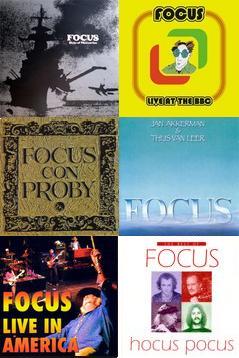
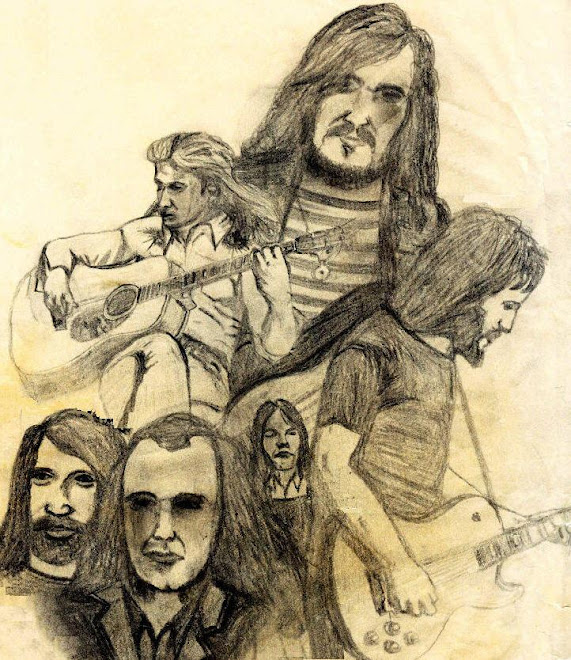
Looking at the music of Dutch rock band Focus, started in the late sixties by Thijs van Leer (b /31/03/48) with Jan Akkerman (b 24/12/46). Van Leer still performs and records under the name today (official site here). Akkerman's site here.

.

.
Showing posts with label Hurkey Turkey. Show all posts

20130326

Track titles that rhyme

Over the years Focus have produced at least five tracks whose title rhymes.
These are

1. Hocus Pocus
2. Harem Scarem
3. Night Flight
4. Hurkey Turkey
5. Flower Shower

20111117

Track by track 115 Remember Mozart/Hurkey Turkey

Archive number: 115
Title: Remember Mozart/Hurkey Turkey
Main Album: Focus 9 (New Skin)
Track number: 3
Genre: Progressive Rock Instrumental
Studio: Fieldwork Studios, Schoten, Belgium
Length: 04:02
Composer: van Leer
Musicians: Thijs van Leer – Hammond organ, piano, keyboard, flute, voice; Niels van der Steenhoven – Guitars; Bobby Jacobs - Bass; Pierre van der Linden - Drums
Producer: Bobby Jacobs and Thijs van Leer
Engineer: Han Nuijten
Label: Red Bullet
Date of recording/release: Summer 2006
Alternative version: None
Notes: Following a drum beat there is a slow, deliberate introduction led by a five note guitar, bass and piano riff, more or less repeated eight or nine times (01:00-0024). Next comes a more tuneful section, hailed by a Mozartian trill and featuring the flute along with the band and harpsichord-like keyboards (from 00:25). This goes on until 01:12 when first the guitar then the keyboard (01:13-01:17) re-introduce the opening theme backed this time by van Leer's improvised flute (01:18-01:40). This leads to the central motif, van Leer's piano and band backed voice, based on the famous Mozart piece Alla Turca (hence the titles). That sections ends at 02:16 (slowing down before speeding up again from 02:02). At 02:17 the opening intro is played in slightly lengthened form for the third and last time, backed this time by squealing and wild electric guitars. At 02:52 we come out again with the tuneful and flute dominated second section broken up only by two brief sections on what sounds like acoustic guitar and keyboard (03:12 03:23) and keyboard with flute (03:41-03:46). The piece ends with a note from the flute.
The third movement of Wolfgang Amadeus Mozart's Piano Sonata No. 11 in A major, K 331 (300i) (from WIkipedia) is a sonata in three movements:
1. Andante grazioso — a theme with six variations 2. Menuetto — a minuet and trio 3. Alla Turca: Allegretto in A minor and major.
All the movements are in the key of A major or A minor; therefore, the work is homotonal. A typical performance of the entire sonata takes about 20 minutes.
It is uncertain where and when Mozart composed it; however, Vienna or Salzburg around 1783 is currently thought to be most likely.
The last movement, Alla Turca, popularly known as the Turkish Rondo or Turkish March, is often heard on its own and is one of Mozart's best-known piano pieces. It imitates the sound of Turkish Janissary bands, the music of which was much in vogue at that time. Various other works of the time imitate this music, including Mozart's own opera The Abduction from the Seraglio.
Repeated notes, repeated ornaments, and loud/soft passages are characteristic of the Alla turca style. The imitation probably came closer with the piano of Mozart's day, whose bass strings made something of a rattle when played loudly, than is possible on modern pianos.
In Mozart's time, the last movement was sometimes performed on pianos built with a "Turkish stop", allowing it to be embellished with extra percussion effects.
Moreover, this third movement is implicitly related to the first one, because the beginning of the "Rondo" can be seen as an additional variation of the "Tema" of the first movement, varied in the Janissary style.

20100219

Track by track 101 Hurkey Turkey

Archive number: 101
Title: Hurkey Turkey
Main Album: Focus 8
Track number: 4
Genre: Progressive Rock Instrumental
Studio: Peptide Studio, Vuren
Length: 4' 07”
Composer: T van der Kaaij, Thijs van Leer
Musicians: Thijs van Leer – Hammond organ, Voices; Jan Dumee – Guitars; Bobby Jacobs - Bass; Bert Smaak - Drums; Geert Scheigrond - Additional guitars.
Producer: Geert Scheijgrond & Focus
Engineer: Geert Scheijgrond & Dick Kemper Label: Musea/Red Bullet
Date of recording/release: A limited run of 500 of the album appeared in August 2002 to be followed by a general release on CD later that year. Also later on Paras and JVC Victor Alternative version: None
Notes: The studio version of Hurkey Turkey starts very distinctively with 8 slightly odd notes on electric guitars followed by a longer ninth one that also features a crash cymbal (00:00-00:08). We then get another two and one then one and one twice and the drums crash in before one of two main themes starts at 00:15 - a bassy riff thing. This is played several times with van Leer's voice in the background and Dumee going up and down the fretboard. At 01:00 there is a slight change of pace announced by the guitar which then takes up more of a lead with the other contrasting theme. This ends at 01:32 when the first theme returns led this time by the Hammond organ (01:33-02:03). We then go back to the guitar-led second theme (02:04-02:34) before the original theme returns with van Leer's voice more prominent at first. This section slows down around 02:44 and from 02:51-03:12 we have a 'scat' section where van Leer's voice is multi-tracked over just drums, one voice providing a jazzy “danga danga danga dang dumdiddy” style and the other a rather crazy turkey voice! The band then come back, with the guitar getting pretty wild and ending with a fade around 04:07.

20090224

Van Leer: the humorous element

One thing that attracted me to Focus’s music as a teenager in the 1970s was its seriousness. Raised on pop music I was tiring of its superficial predictability. Then along came Focus with something quite different. The irony is that if the novelty piece Hocus Pocus had not become an international hit, I may never have discovered Van Leer (and Akkerman's) music. Somewhat unique in being the only yodelling track to consistently feature on albums that showcase the world’s greatest guitarists, it manages somehow, with its claps, shouts, whistles, yodels and blistering guitar riffs both to amuse and amaze. Perhaps the live version on Focus at the Rainbow is the most fun. (On the 1973 American tour, one night poor old Van Leer sang ‘And on the drums Pierre van der Linden’ only to find Colin Allen there – a reminder that not all humour is intentional!)
On Focus Con Proby the question is asked When does a smile begin? There is certainly a vein of humour, especially in Akkerman's work but also in Van Leer's that surfaces at various points. It is certainly in the Focus output and perhaps the search for novelty did dog them. Singles Harem Scarem and Mother Focus tried to capitalise on Van Leer’s distinctive vocals but nothing is quite as much fun or as satisfying as yodelling! An earlier version of Mother Focus is preserved on Ship of Memories, of course, in the weirder, possibly more satisfying, guise of Glider.
Round goes the gossip (the opener on Focus 3) is a track of subtle humour, weirdly enunciated Latin amid a jazz set overlaid with eventually manic voices repeating the title. Both Carnival Fugue and Elspeth of Nottingham (with its cow mooing at the end) are not without humour either. At the end of the second side of what was originally a double album one can appropriately hear weird and manic laughing in the distance. Eruption (Moving Waves) with its call and answer, piano forte style and monastic choir is another track with witty moments. However, in the musical gag department perhaps Hamburger Concerto (Rare, Medium and Well done!), whose very title is a rather old joke, is the most eccentric. It features Van Leer alternately singing male and female opera parts along with an old Dutch hymn sung in a perfectly composed manner amid classical piano and timpani, electric jazz and rock.
Van Leer's solo output and later Focus work is not marked to any great extent by this same sort of humorous approach though it does surface on rare occasions. For example – Super Fishel and Bahama Mama on Nice to have met you with its rather humorous cover (compare the more risque joke on the best of collection Collage) and perhaps I hate myself (for loving you) on the album of that name and Shock treatment on the same album plus Hurkey Turkey Parts 1 and 2 and the rather weird Flower shower (Focus 8 bonus track) - what on earth is going on there? - and possibly European (Rap)sody. Other fun tracks include Finale (Glorious album), the Rondo pieces and several others. Often when doing scat (as on Etudes sans Genes) Van Leer can be very humorous. The name 147 bars (Etudes sans Genes) is a rare example of a humorous enough title. Van Leer, unlike Akkerman, tends not to go in for such things. An example from Focus days would be using the title Anonymus on the first album or the later Mother Focus (no comment) which also includes the closing track Father Bach.
Writing about humour is seldom funny, but like other elements pinpointed in previous articles, humour is an important element in Van Leer's music to some extent and a further part of what makes his body of work the phenomenon it is.

20090223

Thijs van Leer: the Latin element

Having observed the eastern element in the music of Jan Akkerman one looks for something similar in Thijs van Leer's music. It is not really there to the same degree. Obviously he performed Moving Waves and collaborated on Black Beauty, Janis, Dayglow, Hocus Pocus, Love Remembered, Harem Scarem, Indian Summer, etc but a careful examination of the matter reveals that whereas both have been open to all sorts of influences (in 1997, for example, van Leer was working with Senegalese musicians) whereas it is the eastern element that stands out with Akkerman, with van Leer, it is the Latin one.
By Latin we do not mean the language used on Round goes the gossip and Hoeratio but the various musical styles emanating from Latin peoples, chiefly from Latin America (including the Caribbean) but not forgetting Latin Europe. It is not that Akkerman ignores the Latin element (he has studied flamenco guitar, played with Paco de Lucia and recorded music by Villa Lobos and Rodrigo) or that van Leer entirely ignores the eastern element (check out China or Miss Saigon for rare examples) we are simply remarking on a tendency in musical choices. Obviously the bulk of van Leer's work is undergirded by German and other Central European traditions but the Latin element is quite strong.
If we look at the earlier Focus period we note that on several albums the Latin element comes through. On the first album it is Sugar Island, on Focus 3 the equally Caribbean Carnival Fugue. Do not forget either the Philip Catherine number Sneezing Bull. When we listed Focus tracks with an eastern influence above, we mentioned Harem Scarem. Interestingly the counterpoint to any eastern feel there is the introduction of a rather Latin French accordion element, clearly coming from van Leer. The French Latin feel can be heard in several places on the unique solo album Renaissance (1986).
On later Focus albums we have the overtly Latin-influenced Le Tango (a Roselie Peters track that originally appeared on the 1975 solo album O my love! and is also on Introspection 4 from 1980, etc) and the more obliquely Latin Ole Judy from 1985 and then, more recently, Rock 'n' Rio, Hurkey Turkey and De ti o de mi (Focus 8) and It takes 2 2 Tango and Brazil Love (Focus 9).The presence of South American aficionado Jan Dumee at one stage undoubtedly encouraged this South American impetus as well as the enthusiastic fan base that Focus have there. (Dumee had spent time in Brazil studying Brazilian music and has worked with many Latin American musicians). In 2002 Focus performed in Argentina, Brazil, Chile, Mexico, Peru and Venezuela. A limited edition Live in South America album was produced that year and other live recordings from that continent and time exist. Later album tracks have been recorded in Sao Paulo.
A trawl through the van Leer archive will reveal other items that perhaps fit this pattern. On Introspection 2 (1976) we find Goyescas No IV by Granados and on Reflections (1986) the Arioso from Leoncavallo's Pagliacci, not forgetting Bahama Mama from Nice to have met you (1978), various issues of Ravel's Bolero, the Ennio Morricone suite (Introspection 92) and Bernstein's Latinesque America (Musical Melody, 1994).
If the above connections appear a little tentative the same cannot be said of van Leer's involvement with Spanish singer Miguel Rios on three Spanish albums in 1981-1983, the use of Luis Luz as percussionist on the van Leer band album (1987), his appearance on the album Nuevo Tango (1997) with Argentinians Astor Piazolla and Luis Borda and his tours of South America with Dutchman Mike Del Ferro. Several of these contacts seem to have arisen from the early eighties period when van Leer worked with Paul Shigihara and two Chilean musicians – Tato Gomez (bass) and Mario Andragona (drums). As well as working on other projects together, these four produced the modern mass Dona Nobis Pacem (1981) as Pedal Point. The lyrics are all in Latin but with a Spanish lilt. On the sleeve notes they thank Carlos Narea for help, singing on one or two tracks and Juan Edo Fernandez “for his spiritual guidance”.
Latin music is a broad category but it is a useful one to have in mind when considering the very varied influences that have shaped the musical output of Thijs van Leer.
PS Since this article was penned three further Focus albums have appeared and each adds to what is found above. Focus X includes Latin influences such as on Crossroads and Birds come fly over, yet another version of Le Tango, this time featuring Brazilian singer Ivan Lins. He also sings on the Spanish or Portuguese track Santa Teresa which appeared as a bonus track on the Japanese version of Focus X and later on The Focus Family Album. Birds come fly over is sung by Thijs himself on this latter album.
In 2016 Focus released an album of material (8.5 Beyond the Horizon) with friends that was recorded with Brazilian musicians in Brazil. Including, as it does, tracks such as Hola, Como Estas and Inalta this album confirms all that has been said of Thijs van Leer being open to Latin influences.  The guest musicians, such as Arthur Maia and Mario Seve, are big players in the worlds of Brazilian jazz and samba, even if their names are not familiar beyond South America.