Looking at the music of Dutch rock band Focus, started in the late sixties by Thijs van Leer (b /31/03/48) with Jan Akkerman (b 24/12/46). Van Leer still performs and records under the name today (official site here). Akkerman's site here.

.

.
Showing posts with label Akkerman Ruiter Van Leer. Show all posts

20090406

Track by track 91 Sylvia (Live FLIA)

Archive number: 91
Title: Sylvia (Live)
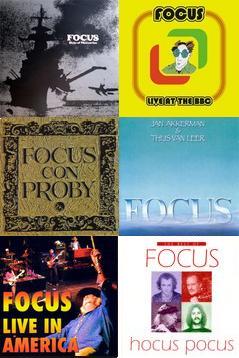
Main Album: Focus Live In America
Track number: 5
Genre: Progressive Rock Instrumental
Venue: Patriots Theater, 1 Memorial Drive, Trenton, New Jersey, USA
Length: 04' 33”
Composer: Thijs van Leer
Musicians: Thijs van Leer – Hammond organ, Voice; Jan Dumee – Gibson Marauder Guitar; Bobby Jacobs - Bass; Bert Smaak - Drums
Producer: Gavin Bott/Bob Carruthers
Engineer: Mike Potter (Orion Sound) Mix (Total audio)
Label: Classical Rock Legends Limited
Date of recording/release: October 2002 (part of a two day Uriah Heep led classic rock legend festival that also featured Nektar, Mostly Autumn and Asia). Released on DVD and CD (edited) in 2003.
Alternative version: Written way back for Sylvia Alberts, the track was first on the album Focus 3.
Notes: On the DVD van Leer says before this track, “We'd like to play for you a short version of number Focus 3 and then specially for you it's a song called Brother.” Not a bad stab, this effort reprises what is essentially the Rainbow version. Dumee provides the high voice parts alongside van Leer's lower ones. The piece actually closes at 03:38 and band introductions from van Leer follow. These reveal this to be an afternoon performance. He calls himself "your organ player" with no reference to his flute here. He then introduces the next track for which see that track.

20090224

Van Leer: the humorous element

One thing that attracted me to Focus’s music as a teenager in the 1970s was its seriousness. Raised on pop music I was tiring of its superficial predictability. Then along came Focus with something quite different. The irony is that if the novelty piece Hocus Pocus had not become an international hit, I may never have discovered Van Leer (and Akkerman's) music. Somewhat unique in being the only yodelling track to consistently feature on albums that showcase the world’s greatest guitarists, it manages somehow, with its claps, shouts, whistles, yodels and blistering guitar riffs both to amuse and amaze. Perhaps the live version on Focus at the Rainbow is the most fun. (On the 1973 American tour, one night poor old Van Leer sang ‘And on the drums Pierre van der Linden’ only to find Colin Allen there – a reminder that not all humour is intentional!)
On Focus Con Proby the question is asked When does a smile begin? There is certainly a vein of humour, especially in Akkerman's work but also in Van Leer's that surfaces at various points. It is certainly in the Focus output and perhaps the search for novelty did dog them. Singles Harem Scarem and Mother Focus tried to capitalise on Van Leer’s distinctive vocals but nothing is quite as much fun or as satisfying as yodelling! An earlier version of Mother Focus is preserved on Ship of Memories, of course, in the weirder, possibly more satisfying, guise of Glider.
Round goes the gossip (the opener on Focus 3) is a track of subtle humour, weirdly enunciated Latin amid a jazz set overlaid with eventually manic voices repeating the title. Both Carnival Fugue and Elspeth of Nottingham (with its cow mooing at the end) are not without humour either. At the end of the second side of what was originally a double album one can appropriately hear weird and manic laughing in the distance. Eruption (Moving Waves) with its call and answer, piano forte style and monastic choir is another track with witty moments. However, in the musical gag department perhaps Hamburger Concerto (Rare, Medium and Well done!), whose very title is a rather old joke, is the most eccentric. It features Van Leer alternately singing male and female opera parts along with an old Dutch hymn sung in a perfectly composed manner amid classical piano and timpani, electric jazz and rock.
Van Leer's solo output and later Focus work is not marked to any great extent by this same sort of humorous approach though it does surface on rare occasions. For example – Super Fishel and Bahama Mama on Nice to have met you with its rather humorous cover (compare the more risque joke on the best of collection Collage) and perhaps I hate myself (for loving you) on the album of that name and Shock treatment on the same album plus Hurkey Turkey Parts 1 and 2 and the rather weird Flower shower (Focus 8 bonus track) - what on earth is going on there? - and possibly European (Rap)sody. Other fun tracks include Finale (Glorious album), the Rondo pieces and several others. Often when doing scat (as on Etudes sans Genes) Van Leer can be very humorous. The name 147 bars (Etudes sans Genes) is a rare example of a humorous enough title. Van Leer, unlike Akkerman, tends not to go in for such things. An example from Focus days would be using the title Anonymus on the first album or the later Mother Focus (no comment) which also includes the closing track Father Bach.
Writing about humour is seldom funny, but like other elements pinpointed in previous articles, humour is an important element in Van Leer's music to some extent and a further part of what makes his body of work the phenomenon it is.

20090218

Track by track 83 Ole Judy

Archive number: 83
Title: Ole Judy
Main Album: Focus (1985)
Track number: 6
Genre: Progressive Rock Instrumental
Studio: Studio Spitsbergen, Zuidbroek, Groningen, The Netherlands (mixed at Dureco Studios, Weesp, The Netherlands)
Length: 03' 44”
Composer: Thijs van Leer
Musicians: Jan Akkerman - Synthesiser Guitar, drum machine; Thijs van Leer – Keyboards inc synthesisers, Flute; Tato Gomez - Bass; Fairlight programmed by Ed Staring.
Producer: Ruud Jacobs with Jan Akkerman, Thijs van Leer and Theo Balijon
Engineer: Emile Elsen, Jan Akkerman and Theo Balijon
Label: Mercury (Phonogram)/Vertigo
Date of recording/release: Recorded 1985 Released LP/CD -1985 CD – 1989
Alternative version: None
Notes: Perhaps the most accessible track on the album, this piece is has a slightly Latin feel but is reminiscent of Birth (Hamburger Concerto) in the juxtaposing of van Leer and Akkerman throughout the song. Van Leer kicks things off with his keyboards, sounding first more reedy (00:00-00:21) then more trumpet like (0:22-0:41) with a trace of flute at the end of the section. Akkerman then steps up to lead with a tough guitar riff (00:42-00:51). We then go back to the trumpet like keyboard briefly (00:52-01:02) before Akkerman has a second stab (01:03-01:23). At this point the flute comes in with gusto (01:24-01:44) before giving way to the trumpet-like keyboards (01:45-02:04) which are inevitably succeeded by the guitar (02:05-02:14). Van Leer's keyboard (02:15-02:35) then flute (02:36-02:45) lead once more before Akkerman closes with a final guitar solo in two parts (02:46-02:51 and 02:52-03:44) that finally fades away.

20080617

Track by track 62 Maximum (Live)

Archive number: 62
Title: Maximum (Live)
Main Album: Live at the BBC
Track number: 3
Genre: Live Funk Instrumental
Venue: New Victoria Theatre, 17 Wilton Road, London SW1V 1LL (now Apollo Victoria)
Length: 13' 58”
Composer: Thijs van Leer
Musicians: Philip Catherine - Electric guitar; Thijs van Leer – Electric Piano, Mellotron, Hammond organ; Voice; Bert Ruiter – Bass; David Kemper - Drums
Producer: BBC
Engineer: BBC
Label: Hux Records
Date of recording/release: Recorded March 21 1976 but only released (on CD) June 1 2004
Alternative version: A shorter version can be found on Focus Con Proby
Notes: This is a number said to date back to Akkerman days. (Some claim to be able to hear its strains on a much later Akkerman solo album). The band begin together (00:00-00:24) with an introductory groove that is followed by a drum-announced electric piano-led burst (00:25-00:29) and a slower groove (00:30-00:52). Another funkier riff (00:53-01:08) then precedes a similarly slow keyboard-led section (01:09-01:37) ended by the guitar. The guitar then leads us into more funky stuff (01:38-02:10) before the main funky riff breaks in again (02:11-02:17) and another slower meandering section follows (02:18-03:26). Here the mellotron is more prominent. The guitar and keyboard lead off on familiar lines (03:27-03:36) but is then more distinctive and percussive (03:37-03:57). At 03:58 a brand new Bach-influenced keyboard section enters. This is punctuated first by a screaming guitar (at 04:09ff) then van Leer's screaming voice (04:31ff). At 04:45 we break down with first the more staccato-style guitar then (04:56) the Bach-influenced keyboards. At 05:07 the screaming guitar is backed by distinctive drumming and we move on via screams from the guitar (05:10-05:18) and van Leer (05:30-05:40) to yet another breakdown (at 05:44). The rises, falls and breaks continue until 07:40-08:27 where there is a decided slowing of pace that eventually picks up in a different vein, led by the guitar (08:28-12:09). Catherine uses pedal effects here and plays some beautiful lines now backed by van Leer's organ as well as other keyboards. We finally break back into the funky groove again at the end, which alternates with the established tune to the end (12:10-13:49). Applause follows and van Leer can again be heard – this time saying 'thank you very much' (13:50-13:58)

20080610

Track by track 60 Virtuous Woman (Live)

Archive number: 60 
Title: Virtuous Woman (Live)
Main Album: Live at the BBC
Track number: 1
Genre: Live Progressive Rock Instrumental
Venue: New Victoria Theatre, 17 Wilton Road, London SW1V 1LL (now Apollo Victoria)
Length: 10' 57”
Composer: Thijs van Leer
Musicians: Philip Catherine - Electric guitars; Thijs van Leer – Hammond organ, Electric Piano, Synthesiser, Voice; Bert Ruiter – Bass; David Kemper - Drums
Producer: BBC
Engineer: BBC
Label: Hux Records Date of recording/release: Recorded March 21 1976 but only released (on CD) June 1 2004
Notes: The applause dies down (00:00-00:13) and we hear van Leer intoning something like an ancient monk, backed chiefly by organ and some percussive sounds (from the guitarists?). He then becomes more operatic (00:09-02:02). After a further brief section dominated by bass (02:03-02:08) Catherine's guitar takes up the lead in jazz style, the organ and bass playing but still nothing from Kemper (02:09-03:15). His cymbals come in near the start of another atmospheric section that follows, featuring also the voice, electric piano and bass (03:16-03:30) then guitar too (03:31-04:06). This becomes more melodic in time (04:07-04:42), the guitar eventually sounding more clearly in a fairly long exploratory and meandering passage (04:43-07:05). An abrupt change announced by drums comes next with the electric piano and guitar leading at first (07:06-07:29) but being superseded by a jazzy scat section from van Leer (07:30-08:12). The previous groove then reasserts itself (08:13-08:40) before another abrupt increase of pace and a further more aggressive passage on guitar (08:41-09:56). Yet another final change of pace sees a reversion to something more sedate (09:57-10:44) and it is in this mood that the piece is played out except for three final fast and loud jazz chords in unison (10:45-10:47). The crowd show their appreciation (10:48-10:57).

20080603

Track by track 50 Mother Focus

Archive number: 50
Title: Mother Focus
Main Album: Mother Focus
Track number: 1
Genre: Progressive Rock Instrumental
Studio: Decca Studios, Hollywood, Los Angeles, California (later Studio 55)
Length: 3' 03”
Composer: Jan Akkerman, Thijs van Leer, Bert Ruiter
Musicians: Jan Akkerman – Acoustic guitars, Electric guitars with talkbox; Thijs van Leer – Piano, Hammond organ, Electric piano; Bert Ruiter – Bass; David Kemper – Drums, Congas
Producer: Hubert Terheggen/Focus
Engineer: Eric Prestidge Label: LP – Polydor, Atco, Philips, EMI Date of recording/release: Recorded 1975, released October 1975. LP – 1975, 1977, CD - 1988
Alternative version: This is a remake of the track originally recorded as Glider, then abandoned but finally preserved on Ship of Memories
Notes: The track begins with acoustic guitar (00:00-00:04) then piano (00:00-00:07) and a high hat (00:08) then bass (00:11) and soon the whole band is playing together with Akkerman working the talk box upfront. At 00:33 van Leer adds classical piano chords and an operatic scat vocal. This all comes to a climax at 01:03. It is followed by a riff from Akkerman while van Leer switches to the organ (01:04-01:36). This eventually winds down before getting back to the original rhythm (01:37-02:09) when it is time for the operatic vocal to come in again (02:10-02:39). This again until drums and voice predominate backed by the band and building to a final climax (02:40-02:57) and the briefest talk box coda (02:58-03:03).
A note on the talk box (from Wikipedia) A talk box is an effects device allowing a musician to modify the sound of his instrument by changing the shape of his mouth. The effect can be used to shape the frequency content of the sound and apply speech sounds (in the same way as singing) onto a musical instrument, typically a guitar or keyboard. An effects pedal is usually used. This contains a speaker attached with an air tight connection to a plastic tube, however, it can come in other forms. The speaker is generally in the form of a horn driver, the sound generating part of a horn speaker with the horn replaced by the tube connection. The box has connectors for the connection to the speaker output of an amplifier and a connection to a normal instrument speaker. A foot-operated on/off switch on the box directs the sound either to the talkbox speaker or the normal speaker. The other end of the tube is taped to the side of a microphone, extending enough to direct the reproduced sound in or near the performer's mouth. When activated, the sound from the amplifier is reproduced by the speaker in the talkbox and directed through the tube into the performer's mouth. The shape of the mouth filters the sound, with the modified sound being picked up by the microphone. The shape of the mouth changes the harmonic content of the sound in the same way it affects the harmonic content generated by the vocal folds when speaking. The performer can vary the shape of the mouth and tongue position, changing the sound of the instrument being reproduced by the talkbox speaker. The performer can mouth words, with the resulting effect sounding as though the instrument is speaking. This "shaped" sound exits the performer's mouth, and when it enters a microphone, an instrument/voice hybrid is heard. The sound can be that of any musical instrument, but the effect is mostly commonly associated with the guitar. The rich harmonics of an electric guitar are shaped by the mouth producing a sound very similar to voice, effectively allowing the guitar to appear to "speak".
Pete Drake, a Nashville mainstay on the pedal steel guitar, first used a talk box in 1964. There is controversy over who invented the commercial device. Bob Heil has claimed he invented it but there is clearly a prior example in the form of the Kustom Electronics device, "The Bag", which is the same concept housed in a decorative bag slung over the shoulder like a wine bottle. This appeared in 1969, two years before Heil's Talk Box. The Bag is said to have been designed by Doug Forbes, who states that the exact same concept (horn driver attached to a plastic tube and inserted into the mouth) had previously been patented as an artificial larynx. In 1973, Heil gave his talk box to Peter Frampton as a Christmas present. Frampton first heard it when Stevie Wonder used it. Then when playing guitar for George Harrison, he saw Pete Drake use it with a pedal steel guitar. He used it extensively on his album Frampton Comes Alive! Due to the success of the album, Frampton became somewhat synonymous with the device. Other early adopters were Jeff Beck and Joe Walsh of the Eagles (in 1973). Akkerman was probably first aware of Joe Walsh though he played with Bogert and Appice who played with Beck.