.

Showing posts with label Carnival fugue. Show all posts
Showing posts with label Carnival fugue. Show all posts
20101025

20090223
Thijs van Leer: the Latin element
 Having observed the eastern element in the music of Jan Akkerman one looks for something similar in Thijs van Leer's music. It is not really there to the same degree. Obviously he performed Moving Waves and collaborated on Black Beauty, Janis, Dayglow, Hocus Pocus, Love Remembered, Harem Scarem, Indian Summer, etc but a careful examination of the matter reveals that whereas both have been open to all sorts of influences (in 1997, for example, van Leer was working with Senegalese musicians) whereas it is the eastern element that stands out with Akkerman, with van Leer, it is the Latin one.
By Latin we do not mean the language used on Round goes the gossip and Hoeratio but the various musical styles emanating from Latin peoples, chiefly from Latin America (including the Caribbean) but not forgetting Latin Europe. It is not that Akkerman ignores the Latin element (he has studied flamenco guitar, played with Paco de Lucia and recorded music by Villa Lobos and Rodrigo) or that van Leer entirely ignores the eastern element (check out China or Miss Saigon for rare examples) we are simply remarking on a tendency in musical choices. Obviously the bulk of van Leer's work is undergirded by German and other Central European traditions but the Latin element is quite strong.
If we look at the earlier Focus period we note that on several albums the Latin element comes through. On the first album it is Sugar Island, on Focus 3 the equally Caribbean Carnival Fugue. Do not forget either the Philip Catherine number Sneezing Bull. When we listed Focus tracks with an eastern influence above, we mentioned Harem Scarem. Interestingly the counterpoint to any eastern feel there is the introduction of a rather Latin French accordion element, clearly coming from van Leer. The French Latin feel can be heard in several places on the unique solo album Renaissance (1986).
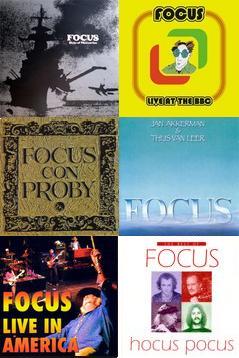
On later Focus albums we have the overtly Latin-influenced Le Tango (a Roselie Peters track that originally appeared on the 1975 solo album O my love! and is also on Introspection 4 from 1980, etc) and the more obliquely Latin Ole Judy from 1985 and then, more recently, Rock 'n' Rio, Hurkey Turkey and De ti o de mi (Focus 8) and It takes 2 2 Tango and Brazil Love (Focus 9).The presence of South American aficionado Jan Dumee at one stage undoubtedly encouraged this South American impetus as well as the enthusiastic fan base that Focus have there. (Dumee had spent time in Brazil studying Brazilian music and has worked with many Latin American musicians). In 2002 Focus performed in Argentina, Brazil, Chile, Mexico, Peru and Venezuela. A limited edition Live in South America album was produced that year and other live recordings from that continent and time exist. Later album tracks have been recorded in Sao Paulo.
A trawl through the van Leer archive will reveal other items that perhaps fit this pattern. On Introspection 2 (1976) we find Goyescas No IV by Granados and on Reflections (1986) the Arioso from Leoncavallo's Pagliacci, not forgetting Bahama Mama from Nice to have met you (1978), various issues of Ravel's Bolero, the Ennio Morricone suite (Introspection 92) and Bernstein's Latinesque America (Musical Melody, 1994).
If the above connections appear a little tentative the same cannot be said of van Leer's involvement with Spanish singer Miguel Rios on three Spanish albums in 1981-1983, the use of Luis Luz as percussionist on the van Leer band album (1987), his appearance on the album Nuevo Tango (1997) with Argentinians Astor Piazolla and Luis Borda and his tours of South America with Dutchman Mike Del Ferro. Several of these contacts seem to have arisen from the early eighties period when van Leer worked with Paul Shigihara and two Chilean musicians – Tato Gomez (bass) and Mario Andragona (drums). As well as working on other projects together, these four produced the modern mass Dona Nobis Pacem (1981) as Pedal Point. The lyrics are all in Latin but with a Spanish lilt. On the sleeve notes they thank Carlos Narea for help, singing on one or two tracks and Juan Edo Fernandez “for his spiritual guidance”.
Latin music is a broad category but it is a useful one to have in mind when considering the very varied influences that have shaped the musical output of Thijs van Leer.
PS Since this article was penned three further Focus albums have appeared and each adds to what is found above. Focus X includes Latin influences such as on Crossroads and Birds come fly over, yet another version of Le Tango, this time featuring Brazilian singer Ivan Lins. He also sings on the Spanish or Portuguese track Santa Teresa which appeared as a bonus track on the Japanese version of Focus X and later on The Focus Family Album. Birds come fly over is sung by Thijs himself on this latter album.
In 2016 Focus released an album of material (8.5 Beyond the Horizon) with friends that was recorded with Brazilian musicians in Brazil. Including, as it does, tracks such as Hola, Como Estas and Inalta this album confirms all that has been said of Thijs van Leer being open to Latin influences. The guest musicians, such as Arthur Maia and Mario Seve, are big players in the worlds of Brazilian jazz and samba, even if their names are not familiar beyond South America.
20090219
Focus fades
The fade is used by Focus quite sparingly, except on Mother Focus, where nearly half the tracks fade. It is usually adopted where a live piece has no obvious ending. Tracks using a fade include these
1. Why dream (In and out)
2. Round goes the gossip, Carnival fugue and Sylvia (Focus 3)
3. The US or fast version of Hocus Pocus
4. Early Birth
5. Red sky at night
6. Bennie Helder, My Sweetheart, All together ... Oh that!, Hard Vanilla and No Hang Ups (Mother Focus) 7. Nightflight and Wingless (Focus Con Proby)
8. Le Tango, Who's calling and Beethoven's Revenge (Focus 1985)
9. Fretless love, Hurkey Turkey, De ti O de mi (Focus 8)
10. Father Bacchus, Hoeratio and Crossroads (Focus X)
11. Five fourth (Focus Family Album)
20080103
Track by track 19 Carnival Fugue
Archive number: 19
Title: Carnival Fugue
Main Album: Focus 3
Track number: 4
Genre: Jazz Rock Instrumental
Studio: Olympic Studios 'B', 117 Church Road, Barnes, London SW13 9HL
Length: 06' 04"
Composer: Thijs van Leer
Musicians: Jan Akkerman – Electric guitars (Gibson Les Paul Customs?), acoustic guitar; Thijs van Leer – Hammond organ, piano, piccolo; Bert Ruiter - Bass; Pierre Van Der Linden – Drums
Producer: Mike Vernon
Engineer: George Chkiantz
Label: LP – Imperial, Polydor, Sire CD – Capitol, EMI-Bovema, IRS, Red Bullet, JVC Victor
Date of recording/release: July 1972/November 1972, 1975 CD - 1988, 1993, 2001, 2002, 2004
Alternative version: There does not appear to be a different version of this anywhere but some sections were later used by van Leer in quite a different (more obviously fugal) way on the 1981 Pedal Point album Dona Nobis Pacem (in the first Sanctus).
Notes: The piece can be divided into four sections. The first (00:00-01:30) is slow and solemn and features piano, electric guitar and very sparing drum fills using floor toms and cymbals. The piece begins just with piano but is complimented by laid back, meandering guitar lines. The music evokes the lack of activity before a carnival march starts. There is a four second gap between the first and second section (00:31-00:34). The second section (01:35-02:55) features piano again but now with acoustic guitars from the start and (from 00:49) bass and drums. This brisker section features rising scales and evokes perhaps the readying of carnival marchers. This leads into a third even quicker, more jazzy (or contrapuntal) transitional section (02:56-03:29) on the same instruments. By now the whole troupe is more than ready for the off and the final section is a lively 'carnival' style one, Caribbean perhaps, in its feel (03:30-06:04). It features piccolo, organ, electric guitar, bass and drums. An infectious joy permeates as the music eventually fades, the revellers, as it were, passing into the distance. Overdubbing has been used to enhance the piccolo lines and contrasting guitar lines come from the two channels at certain points.
A note on the term fugue (from Wikipedia)
The English term fugue originates in the 16th Century and is from French or Italian fuga, which itself is from Latin and is related to both fugere (to flee) and fugare (to chase). The adjectival form is fugal. Variants include fughetta (lit a small fugue) and fugato (passage in fugal style within another work that is not a fugue).
In music, a fugue is a type of contrapuntal composition or technique of composition for a fixed number of parts, normally referred to as "voices", irrespective of whether the work is vocal or not. In the Middle Ages, the term was widely used to denote any works in canonic style; by the Renaissance, it came to denote specifically imitative works. Since the 17th Century the term has described what is commonly regarded as the most fully developed procedure of imitative counterpoint. A fugue opens with one main theme (subject) which then sounds successively in each voice in imitation; when each voice has entered, the exposition is complete; usually this is followed by a connecting passage (episode) developed from previously heard material; further "entries" of the subject then are heard in related keys. Episodes and entries are usually alternated until the "final entry" of the subject, by which point the music has returned to the opening key, or tonic, which is often followed by closing material, the coda. In this sense, fugue is a style of composition, rather than a fixed structure. Though there are certain established practices, in writing the exposition for example, composers approach the style with varying degrees of freedom and individuality.
The form evolved from several earlier types of contrapuntal compositions, such as imitative ricercars, capriccios, canzonas and fantasias. Middle and late Baroque composers such as Buxtehude (1637–1707) and Pachelbel (1653–1706) contributed greatly to the development of the fugue, and the form reached ultimate maturity in the works of Bach (1685–1750). With the decline of sophisticated contrapuntal styles at the end of the baroque period, the fugue's popularity as a compositional style waned, eventually giving way to Sonata form.
Nevertheless, composers from the 1750s to the present day continue to write and study fugue for various purposes; they appear in the works of Mozart (eg Kyrie Eleison, Requiem in D min) and Beethoven (eg end of Credo, Missa Solemnis) and composers such as Reicha (1770–1836) and Shostakovich (1906–1975) wrote cycles of fugues.
Subscribe to:
Posts (Atom)