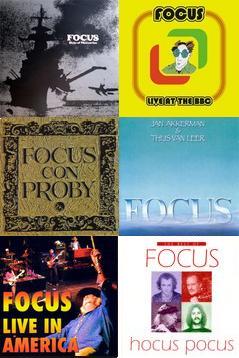
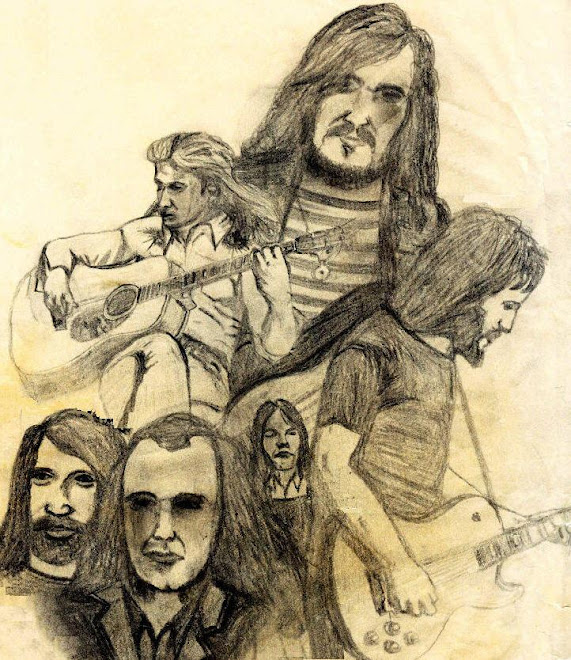
Looking at the music of Dutch rock band Focus, started in the late sixties by Thijs van Leer (b /31/03/48) with Jan Akkerman (b 24/12/46). Van Leer still performs and records under the name today (official site here). Akkerman's site here.

.

.
Showing posts with label Van der Linden. Show all posts

20240711

Track by track 204 Meta Indefinita

Main Album: Focus 12
Title: Meta Indefinita
Track number: 4
Genre: Progressive Rock Instrumental
Studio: Wisseloord Studios, Hilversum, Netherlands
Length: 4:36
Composer: Pierre van der Linden
Musicians: Thijs van Leer – Hammond organ, flute; Menno Gootjes – Guitars; Udo Panekeet – Bass; Pierre van der Linden – Drums
Producer: Udo Pannekeet and Menno Gootjes
Label: Spirit of the Unicorn
Date of recording/release: July 2024
Alternative recording: None
Notes: The atmospheric track, said to be improvised, begins with a solo reverberating guitar. At around 00:20 a flute joins in and a bass guitar, mostly harmonics. The cymbals and drums are also heard from around 01:10 and begin to dominate but with guitar chords too and then flute and bass. From 03:31 the guitar is briefly 'violined'. Everything slows down after that and the piece drifts out much the way it drifted in. The title is the equivalent to something like no limits.

20081201

Focus Drummers

The main Focus drummer has been Pierre Van Der Linden who originally worked with Jan Akkerman in Brainbox. After leaving in 1973 he rejoined the band more than once. The original drummer was Hans Cleuver. In the early days on at least one trip Akkerman's late brother Cocky sat in. Other main drummers have been the Englishman Colin Allen, the Americans David Kemper and Steve Smith and the appropriately named Dutchman Bert Smaak. When the current Focus first reformed the drummer was Ruben Van Roon and in 2004 Hans van Oosterhout was playing with them. Other Focus drummers include Richard James and Henk Zomer (one gig in Amersfoort in 1977).

20080306

Track by track 38 Ship of Memories

Archive number: 38
Title: Ship of Memories
Main Album: Ship of Memories
Track number: 9
Genre: Instrumental
Studio: Chipping Norton Recording Studio, 26-32 New Street, Chipping Norton, Oxon, OX7 5LJ
Length: 1' 42”
Composer: Pierre van derLinden
Musicians: Pierre van der Linden – Drums, Harmonium
Producer: Mike Vernon
Engineer: Barry Hammond and David Grinsted
Label: LP – EMI, Harvest, Sire CD – EMI-Bovema, IRS, Red Bullet, JVC Date of recording/release: Final weeks of May 1973. Not released until 1977 (LP). CD – 1988,1993, 2001, 2006.
Notes: Again quite atmospheric this track, the last of the Chipping Norton remnants, would originally have begun with a lengthy drum break, perhaps something like The Lost Past on the self-titled album by Trace. We break in at the point where there is a loud crash on the drums and a drum roll ending with cymbals and leading (00:19) into the main part played on harmonium (an instrument also used briefly on Hocus Pocus). The cymbals carry on until 00:45 when sound effects of wind then seagulls begin. The harmonium slowly fades until only the sound of the wind remains. As what was expected to be the last published track from a great band it is a good choice.
A note on the harmonium (from Wikipedia)
A harmonium is a free-standing musical keyboard instrument similar to a reed organ or pipe organ. It consists of free reeds and sound is produced by air being blown through reeds resulting in a sound similar to that of an accordion. The air is supplied by foot-operated (or, as with the type of harmonium used in Indian music, hand-operated) bellows alternately depressed by the player. The harmonium was invented in Paris in 1842 by Alexandre Debain, though there was concurrent development of similar instruments. Christian Gottlieb Kratzenstein (1723-1795), Professor of Physiology at Copenhagen, was credited with the first free reed to be made in the western world after winning the annual prize in 1780 from the Imperial Academy of St Petersburg. Harmoniums reached the height of their popularity in the West in the late 19th and early 20th Centuries. They were especially popular in small churches where a pipe organ would be too large or too expensive. Dvorak, Franck, Schoenberg and Rossini are among classical composers who have written for the instrument. The Beatles and others have also made use of it.

20071217

Track by track 15c Eruption (Part 3 - Euridice, Dayglow, Endless Road)

Archive number: 15c
Title: Eruption (Part 3 - Euridice, Dayglow, Endless Road)
Main Album: Moving Waves (Focus 2 in Holland)
Track number: 6c
Genre: Progressive Rock (Symphonic) Studio: Sound Techniques Studio, 46a Old Church Street, Chelsea, London SW3
Length: 5' 25" (22' 57" the whole)
Composer: Thijs van Leer, (Tom Barlage, Jan Akkerman), Eelko Nobel, Pierre van der Linden
Musicians: Jan Akkerman – Electric guitars (Gibson Les Paul Customs), Bass; Thijs van Leer – Hammond organ, Piano, Voice, Flute, Mellotron; Cyriel Havermans - Bass; Pierre van der Linden - Drums
Producer: Mike Vernon
Engineer: Jerry Boys
Label: LP - Imperial, Blue Horizon CD – EMI Bovema, IRS, Red Bullet
Date of recording/release: April, May 1971/October 1971. CD - 1988, 1993, 2001
Alternative version: The original Eelko Nobel contribution can be heard briefly in the background on the Ramses Shaffy album Sunset Sunkiss.
Notes: Eruption is a brilliant composite piece that pulls together various musical elements. Album notes refer to as many as 15 different parts though the nature of the music means that there are overlaps and the debatable nature of deciding just where one part ends and another begins is reflected in the varied timings given. We present here our own attempt to convey what is included.
14:35-20:00
There is a definite caesura or pause at 14:35 and then we enter on the third and penultimate section.
14:36-16:16 Euridice
First we have Euridice by Eelko Nobel (van Leer's fellow singer when he was working with Ramses Shaffy). This begins with beautiful piano and guitar, then the organ comes in. The flute takes up the lead at 15:14 with bass. From 15:53 to 16:16 it is the heavily reverbed solo flute that rounds off the piece.
16:17-17:53 Dayglow
The next part begins with a monk-like voice and organ to be succeeded (16:47-17:19) by organ and 'violined' guitar. At 17:18 a mellotron comes in featuring voices and a horn-like sound. At 17:52 a transition is signalled with bass, cymbals and the horn-like mellotron.
18:24-20:00 Endless Road
This transitional part leads into van der Linden's drumbreak.