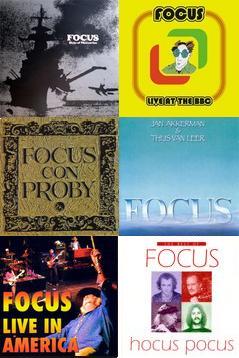
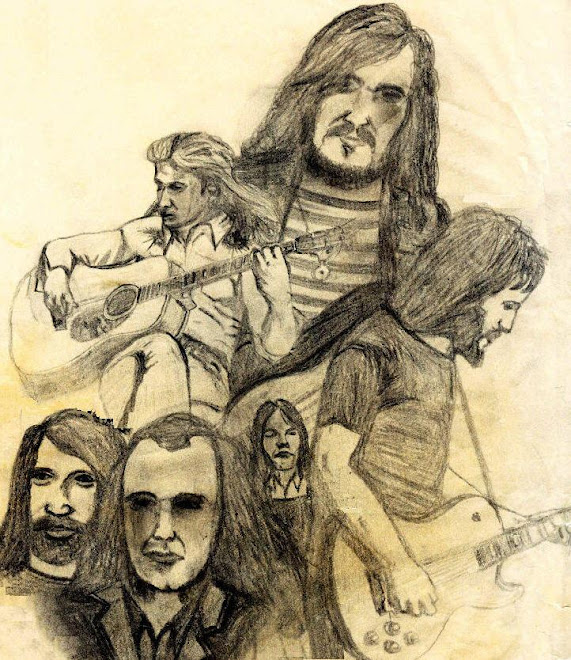
Looking at the music of Dutch rock band Focus, started in the late sixties by Thijs van Leer (b /31/03/48) with Jan Akkerman (b 24/12/46). Van Leer still performs and records under the name today (official site here). Akkerman's site here.

.

.

20090327

Focus not Focus

There are a small number of almost forgotten tracks that are not exactly by Focus but that technically do feature the band.
The oldest of these are the 1969 or 1970 recordings of the Amsterdam cast of the controversial musical Hair. Van Leer, Akkerman, Dresden and Cleuver form the nucleus of a 10 piece orchestra led by Del Newman with the cast singing. They can be heard, for example, on the opening introduction to Aquarius and the closing Hare Krishna. From that period there is also a short recording with Ronald Snellenberg called Mijn Overtuiging.
In the same period Van Leer was working with Ramses Shaffy and on an album containing two long tracks on each side, Sunset and Sunkiss, the whole band plays on Sunset. In 1969 a Ramses Shaffy single (the highly didactic The shrine of God b/w Watch out for the ugly people) appeared with Focus as the backing group. Slightly later, Van Leer was involved in producing an album by Hans Cleuver's wife Bojoura (Beauty of Bojoura) and the band again appear on The Last Thing On My Mind. (The Akkerman, Van Leer composition Why do they go back home seems to feature Akkerman, Van Leer and Dresden but not Cleuver.)
In 1973 Focus' bassist Cyriel Havermans left to make a solo album (Cyril) and called on his former colleagues for help. Pierre Van Der Linden is on several tracks usually with Van Leer but Share Those Dreams is the only track featuring Van Leer, Akkerman and Cyril.
It is perhaps also worth mentioning here that Jan Akkerman performed with the Van Leer Band in the 1980s but no official recordings were released.
(For the Ramses Shaffy single check here)

20090303

Progressive Rock?

Today's official website boasts of Focus as De ultieme progressieve rockgroep. But are they really a prog rock band? Being interviewed last year Thijs Van Leer said “I know some rock musicians call us ‘The Godfathers of Progressive Rock’, but I describe the music as songs without words. It is influenced by European classical music, R’n’B, folk and jazz. It’s very much improvisational and has a signature all of it’s own.”
Progressive rock has been described as “an ambitious, eclectic, and often grandiose” form of rock music that evolved in the late sixties and early seventies as part of a “mostly British attempt to elevate rock music to new levels of artistic credibility.” Pushing “rock's technical and compositional boundaries” it went beyond the standard rock or popular verse-chorus-based song structures. Additionally, arrangements often incorporated elements drawn from classical, jazz, folk and world music. Instrumentals were common.
Prog rock developed from psychedelic rock as part of a wide-ranging tendency in the rock music of the era to draw inspiration from ever more diverse influences. Prog rock reached the peak of its popularity in the 1970s but continues to this day. The term became widespread in the mid-1970s and was applied to music by bands such as King Crimson; Yes; Genesis; Jethro Tull; Camel and was often applied to Focus. Is it appropriate? Perhaps it is best to answer yes and no.
Yes
Do Focus avoid common popular music song structures (eg verse-chorus-bridge) or blur formal distinctions by extending sections or inserting musical interludes, often with exaggerated dynamics to heighten the contrast between sections? Yes.
Are classical forms often inserted or substituted, sometimes yielding entire suites, building on the traditional medleys of earlier rock bands? Again, yes.
Do we get extended instrumental passages, marrying the classical solo tradition with the improvisational traditions of jazz and psychedelic rock, leading often to lengthy tracks? That is certainly there.
There is also distinctive instrumentation and tone colour with the use of flute and lute and limited experimentation with unusual keyboard sounds.
What about the exploration of time signatures other than 4/4 and tempo changes, inspired by classical, jazz, folk and experimental influences? Once again, it is yes. The freer rhythmic approach of prog rock is certainly there too.
Similarly, when it comes to melody and harmony the blues inflections of mainstream rock are supplemented by jazz and classical influences. Longer, developing passages are more common than short, catchy ones. Allusions to, or even direct quotes from, well-known classical themes appear.
No
On the other hand, ambient soundscapes and theatrical elements are not really part of the Focus scene and although Focus showed some interest in new electronic musical instruments and technologies, it was never to the fore. Mellotrons and synthesisers were used sparingly and in its current incarnation Focus pretty much avoids them. There has never been a Focus concept album either. The general lack of lyrics has also meant that themes from classical literature, fantasy and folklore (the stuff of many a prog rock band) have never been explored. Album art has never been a big part of Focus's appeal, either and as for stage theatrics the very opposite was generally true of the quiet Dutchmen. Unlike Genesis, Keith Emerson and others, for Focus the music is everything.
A qualified answer is necessary, therefore. Are Focus Prog rock? Yes, but in a way unlike any other prog rock band. Indeed, a unique style.

20090224

Akkerman: the humorous element

Most British audiences sat listening to Focus very soberly and the humour was perhaps overlooked. My tendency was certainly to be a little over earnest in my devotion. For example, I always listened to Focus 2 (Moving Waves) with a certain awe, oblivious to any echo of the 007 theme. On hearing for the first time the version on Akkerman's live album 10,000 Clowns (1997), where he slips in a brief quotation of the Bond theme, I burst out laughing. A similar musical joke appears on Live at Alexander’s (1999) on Pietons. This time we briefly hear the Flintstones theme (to the momentary alarm of the other musicians, as I recall). This, it turns out, is a widely known joke among Jazz musicians.
Hocus Pocus was not Akkerman's first foray into novelty. In 1969 The Hunters were number one in Holland with a cold war inspired vocal number The Russian spy and I, featuring hot guitar work, in balalaika style, from Akkerman, then an up and coming 18 year old. Some may say ‘Niet’ but I would argue that it bears hearing today both as artifact of social and political history and attractive guitar virtuoso pop.
We have written of van Leer's humour but with Akkerman the humorous element is, if anything, more pronounced. In 1981 he made a solo album that is pure fun throughout. Apparently Oil in the Family was produced, perhaps uniquely, in just 48 hours in response to a Dutch radio producer’s challenge. Jan came up with what can best be described as a Middle Eastern disco record (one track is Disc-o-asis!) that is pure jest throughout. You may feel the joke is wearing thin by now but it still stands up as a good fun album. There are plenty of other fun tracks too. It is difficult to listen without smiling to Green Onions (Guitar for Sale), Kemp’s jig and Minstrel/farmer’s dance (Profile), Crackers (available in several versions) or Quiet Storm (Art of Noise). There is even a track simply called Having Fun (also on Art of Noise). Until Flower Shower the Mother Focus track, I need the bathroom, (featuring a rare vocal from Akkerman himself?), was the wackiest item ever released by Focus.
Clearly in the making of most of Akkerman’s albums there has been plenty of laughter. Can’t stand noise originally had a closing track (Who knows) that ended rather abruptly. The story goes that the beautiful summer weather of 1983 prompted an attempt at outdoor recording. No sooner was everything set up for Akkerman to perform than a thunderclap announced a pending storm and everyone rushed back inside. The track Status Quo (From the Basement) ends with Dino Walcott breaking into fits of uncontrollable laughter. Jan explains in part "We were all standing together in the control room, while Dino was standing in the studio with his mouth organ. We were laughing our heads off, while the drum machine kept on going, and then Dino also started to laugh."
Akkerman loves punning (as in his trade mark ‘Thank you very Dutch’) and humour of a more unusual sort. His sense of fun comes out in several ways on albums. Even on a pretty serious album like Live at the Priory there are amusing remarks between songs (eg in response to the plea for more, ‘People. I’m dying for a fag!’). Occasionally, there has been jocund art work. The album cover where Jan shares his bed with an amorous guitar comes to mind as does the carefully conceived Noise of art jacket. I also like the two perspiring plastic pieces on the Transparental album with Kaz Luz and the In and out of Focus gatefold sleeve edition where the word Focus literally goes in and out of focus. Word play often features. On Puccini’s Café, produced after a serious road accident, we find for the first time song writing credits to M Muleta. Who is Mr Muleta? Ask Jan and he will tell you it is his old lady or that it is the Spanish for a bull fighter’s cloak. Try saying ‘em-mue-later’ however and you might see the joke. It is a little like A. Rab credited on some Oil in the Family tracks. It’s Jan again, this time acknowledging an unknown Middle Eastern writer from whom he borrowed. Some track and album titles are puns or jokes. The come back album Art of noise is a neat inversion. It includes the whimsical track title, You can’t keep a bad man up. Among bonus tracks released on three albums in 1998 we note, When I was a cocktail in a waitress bar, 39 seconds (that’s enough for that pilgrim), Akkermani and A town near Odessa (inspired by a town called Akkerman!). Think too of Ab-so-rocking-lutely, D.Jan.go and Knight of the lute on Passion. Akkerman loves to rework tracks. This gives opportunity for droll punning. Heavy pleasure, Heavy treasure; Primadonna, Pre Madonna; Streetwalker, Weedstalker; Milestones, Akkerstones; not to mention Sylvia’s grandmother and Soft Focus or Birth and Early birth. Again like elements pinpointed in other articles, humour is an important element in Akkerman’s music and a further part of what makes his body of work the phenomenon it is.

Van Leer: the humorous element

One thing that attracted me to Focus’s music as a teenager in the 1970s was its seriousness. Raised on pop music I was tiring of its superficial predictability. Then along came Focus with something quite different. The irony is that if the novelty piece Hocus Pocus had not become an international hit, I may never have discovered Van Leer (and Akkerman's) music. Somewhat unique in being the only yodelling track to consistently feature on albums that showcase the world’s greatest guitarists, it manages somehow, with its claps, shouts, whistles, yodels and blistering guitar riffs both to amuse and amaze. Perhaps the live version on Focus at the Rainbow is the most fun. (On the 1973 American tour, one night poor old Van Leer sang ‘And on the drums Pierre van der Linden’ only to find Colin Allen there – a reminder that not all humour is intentional!)
On Focus Con Proby the question is asked When does a smile begin? There is certainly a vein of humour, especially in Akkerman's work but also in Van Leer's that surfaces at various points. It is certainly in the Focus output and perhaps the search for novelty did dog them. Singles Harem Scarem and Mother Focus tried to capitalise on Van Leer’s distinctive vocals but nothing is quite as much fun or as satisfying as yodelling! An earlier version of Mother Focus is preserved on Ship of Memories, of course, in the weirder, possibly more satisfying, guise of Glider.
Round goes the gossip (the opener on Focus 3) is a track of subtle humour, weirdly enunciated Latin amid a jazz set overlaid with eventually manic voices repeating the title. Both Carnival Fugue and Elspeth of Nottingham (with its cow mooing at the end) are not without humour either. At the end of the second side of what was originally a double album one can appropriately hear weird and manic laughing in the distance. Eruption (Moving Waves) with its call and answer, piano forte style and monastic choir is another track with witty moments. However, in the musical gag department perhaps Hamburger Concerto (Rare, Medium and Well done!), whose very title is a rather old joke, is the most eccentric. It features Van Leer alternately singing male and female opera parts along with an old Dutch hymn sung in a perfectly composed manner amid classical piano and timpani, electric jazz and rock.
Van Leer's solo output and later Focus work is not marked to any great extent by this same sort of humorous approach though it does surface on rare occasions. For example – Super Fishel and Bahama Mama on Nice to have met you with its rather humorous cover (compare the more risque joke on the best of collection Collage) and perhaps I hate myself (for loving you) on the album of that name and Shock treatment on the same album plus Hurkey Turkey Parts 1 and 2 and the rather weird Flower shower (Focus 8 bonus track) - what on earth is going on there? - and possibly European (Rap)sody. Other fun tracks include Finale (Glorious album), the Rondo pieces and several others. Often when doing scat (as on Etudes sans Genes) Van Leer can be very humorous. The name 147 bars (Etudes sans Genes) is a rare example of a humorous enough title. Van Leer, unlike Akkerman, tends not to go in for such things. An example from Focus days would be using the title Anonymus on the first album or the later Mother Focus (no comment) which also includes the closing track Father Bach.
Writing about humour is seldom funny, but like other elements pinpointed in previous articles, humour is an important element in Van Leer's music to some extent and a further part of what makes his body of work the phenomenon it is.

20090223

Thijs van Leer: the Latin element

Having observed the eastern element in the music of Jan Akkerman one looks for something similar in Thijs van Leer's music. It is not really there to the same degree. Obviously he performed Moving Waves and collaborated on Black Beauty, Janis, Dayglow, Hocus Pocus, Love Remembered, Harem Scarem, Indian Summer, etc but a careful examination of the matter reveals that whereas both have been open to all sorts of influences (in 1997, for example, van Leer was working with Senegalese musicians) whereas it is the eastern element that stands out with Akkerman, with van Leer, it is the Latin one.
By Latin we do not mean the language used on Round goes the gossip and Hoeratio but the various musical styles emanating from Latin peoples, chiefly from Latin America (including the Caribbean) but not forgetting Latin Europe. It is not that Akkerman ignores the Latin element (he has studied flamenco guitar, played with Paco de Lucia and recorded music by Villa Lobos and Rodrigo) or that van Leer entirely ignores the eastern element (check out China or Miss Saigon for rare examples) we are simply remarking on a tendency in musical choices. Obviously the bulk of van Leer's work is undergirded by German and other Central European traditions but the Latin element is quite strong.
If we look at the earlier Focus period we note that on several albums the Latin element comes through. On the first album it is Sugar Island, on Focus 3 the equally Caribbean Carnival Fugue. Do not forget either the Philip Catherine number Sneezing Bull. When we listed Focus tracks with an eastern influence above, we mentioned Harem Scarem. Interestingly the counterpoint to any eastern feel there is the introduction of a rather Latin French accordion element, clearly coming from van Leer. The French Latin feel can be heard in several places on the unique solo album Renaissance (1986).
On later Focus albums we have the overtly Latin-influenced Le Tango (a Roselie Peters track that originally appeared on the 1975 solo album O my love! and is also on Introspection 4 from 1980, etc) and the more obliquely Latin Ole Judy from 1985 and then, more recently, Rock 'n' Rio, Hurkey Turkey and De ti o de mi (Focus 8) and It takes 2 2 Tango and Brazil Love (Focus 9).The presence of South American aficionado Jan Dumee at one stage undoubtedly encouraged this South American impetus as well as the enthusiastic fan base that Focus have there. (Dumee had spent time in Brazil studying Brazilian music and has worked with many Latin American musicians). In 2002 Focus performed in Argentina, Brazil, Chile, Mexico, Peru and Venezuela. A limited edition Live in South America album was produced that year and other live recordings from that continent and time exist. Later album tracks have been recorded in Sao Paulo.
A trawl through the van Leer archive will reveal other items that perhaps fit this pattern. On Introspection 2 (1976) we find Goyescas No IV by Granados and on Reflections (1986) the Arioso from Leoncavallo's Pagliacci, not forgetting Bahama Mama from Nice to have met you (1978), various issues of Ravel's Bolero, the Ennio Morricone suite (Introspection 92) and Bernstein's Latinesque America (Musical Melody, 1994).
If the above connections appear a little tentative the same cannot be said of van Leer's involvement with Spanish singer Miguel Rios on three Spanish albums in 1981-1983, the use of Luis Luz as percussionist on the van Leer band album (1987), his appearance on the album Nuevo Tango (1997) with Argentinians Astor Piazolla and Luis Borda and his tours of South America with Dutchman Mike Del Ferro. Several of these contacts seem to have arisen from the early eighties period when van Leer worked with Paul Shigihara and two Chilean musicians – Tato Gomez (bass) and Mario Andragona (drums). As well as working on other projects together, these four produced the modern mass Dona Nobis Pacem (1981) as Pedal Point. The lyrics are all in Latin but with a Spanish lilt. On the sleeve notes they thank Carlos Narea for help, singing on one or two tracks and Juan Edo Fernandez “for his spiritual guidance”.
Latin music is a broad category but it is a useful one to have in mind when considering the very varied influences that have shaped the musical output of Thijs van Leer.
PS Since this article was penned three further Focus albums have appeared and each adds to what is found above. Focus X includes Latin influences such as on Crossroads and Birds come fly over, yet another version of Le Tango, this time featuring Brazilian singer Ivan Lins. He also sings on the Spanish or Portuguese track Santa Teresa which appeared as a bonus track on the Japanese version of Focus X and later on The Focus Family Album. Birds come fly over is sung by Thijs himself on this latter album.
In 2016 Focus released an album of material (8.5 Beyond the Horizon) with friends that was recorded with Brazilian musicians in Brazil. Including, as it does, tracks such as Hola, Como Estas and Inalta this album confirms all that has been said of Thijs van Leer being open to Latin influences.  The guest musicians, such as Arthur Maia and Mario Seve, are big players in the worlds of Brazilian jazz and samba, even if their names are not familiar beyond South America.

20090219

Jan Akkerman: the eastern element


In an interview in Odessa, Ukraine, in 2005 Jan Akkerman said “I think I have Russian roots. My aunt told me that one of my great-grandmothers was from the Akkerman region (a nearby fortress does have the name Akkerman) where were then living the Dutch merchantmen who traded between South Russia and Holland. My last name seems to be very eloquent in this respect, though sometimes I think I can't be completely certain in that. All in all, I don't have a wish to delve into my genealogy, but I believe my ancestors were from here.” No doubt he was not wholly serious but if you listen to Akkerman's music you will see that there is something in what he says. Eastern music is notoriously difficult to define but something definitely happens to harmony and rhythm east of a point somewhere in line with Vienna that is quite distinct. This eastern element can be found in several places throughout Akkerman's work. In recent years Akkerman and his band have played live in Mumbai, in Japan, in the middle east and other places east of Vienna and he has sometimes deliberately brought out this eastern element in these places. The current very eastern version of
House of the King (Palace of the King) typifies it. If truth be told, however, House of the King always did have something eastern about it, something first declared unequivocally in the electric sitar version found on the solo album Tabernakel. Like many others in the UK my first introduction to Akkerman's music was the album Moving Waves with Focus. One feature of that album was its unique sound. It was quite different to much of the rock music around at the time. Its European sound was often referred to. However, not only did it sound pretty European but in certain places there was an undoubtedly eastern feel to it. Think of a track like Janis for example, with its distinctly eastern flutes or certain parts of the long track Eruption, especially Dayglow. Hocus Pocus and the title track also share this eastern feel. (Vanessa Mae's version of Hocus Pocus brings out the eastern element very well). This was the early seventies, of course. The Beatles and others had already blazed a trail to India and back so this element was a very contemporary one. Jan appears on the original cover, if you remember, wearing a state of the art khaftan. A similar phenomenon is faintly recognisable on the first and third Focus albums (although to be fair, both albums contain tracks firmly in the Caribbean tradition and so no corner of the globe is entirely neglected). Check out Black Beauty or Love Remembered for example. Harem Scarem and parts of Hamburger Concerto (especially Medium 1) also contain quite eastern elements. Akkerman's eastern credentials go back a long way. His art was cradled in the very beginnings of Dutch rock in the fifties, when the Tielman brothers from Indonesia and their Indo-rock style dominated the Dutch scene. In a recent interview Akkerman has said that there were “a lot of Indonesian kids in the area where I grew up, and we played blues and rock & roll”. That surf rock sound always did have an eastern leaning and the influence can be detected in the early music of Akkerman and others. (The eastern influence on Dick Dale for example is widely acknowledged). Akkerman also admits freely to other early eastern influences from gypsies and from Balkan music. Before his Focus days the eastern element can also be detected in the Jewish traditional, Hineimatov, on the first solo album, on the Russian styled hits with The Hunters The Russian spy and I and Janosh (revisited on Russian Roulette with Van Leer in 1985) and quite obviously on the Brainbox track Dark Rose. By the time we come to the solo album Tabernakel Akkerman is featuring, at certain points, both the electric and the acoustic sitar. For some reason the sitars are not credited on the original album but it is an open secret that in the seventies and eighties Jan often used a Coral electronic sitar. This sitar also apparently features on the later Focus track Glider (on Ship of Memories). Jan also played it in public at the end of 1974 at a Brainbox reunion concert, later shown on Dutch television. With regard to the early solo albums Profile and Tabernakel, it is interesting that Akkerman plays the oudh-like lute rather than, say, a banjo! In the seventies Akkerman played and recorded a lot with Neppie Noya the Indonesian born percussionist and son of Japanese Taiko drummer Fusao Nakato San. Later on, the legendary 1981 album Oil in the family features a very eastern style cover, reflecting the strong presence of eastern style melodies on most tracks. Jan actually credits A. Rab (!) as composer on certain tracks in an effort to acknowledge his borrowings from unknown middle-eastern musicians. Some live performances of this material actually featured the use of a belly dancer. The album apparently went down very well in Turkey. With subsequent albums the eastern element is perhaps excluded, though in 1985 on the track Indian Summer with Thijs Van Leer an Indian tabla player based in Holland (Ustad Zamir Ahmad Khan) is brought in and some have detected it, for example, on some of the percussion for The noise of art (1990), the track Saudade on Focus in time (1996) and the opening track See you! on CU (2003). How much direct Akkerman influence there may be in the Forcefield tracks Year of the Dragon and Tokyo (on their second and third albums of 1988 and 1989) we do not know. The more one is aware of this eastern element, however, the more one can hear it perhaps.

Akkerman Solo


Before joining Focus Jan Akkerman had produced a solo album - the 1969 instrumental album Guitar for sale. While still with Focus he produced Profile and Tabernakel and the collaboration with Peter Banks (Two sides of Peter Banks 1973). Between the break up of Focus and the 1985 reunion with Van Leer in 1985 he produced several diverse albums, including a self-titled album (1977) and a live album with similar content the following year (Live in Montreux). The very classically oriented Aranjuez with Claus Ogerman also appeared in 1978. In 1980 the funky Jan Akkerman 3 appeared and in 1981 the Arab disco influenced Oil in the family. The 1982 album Pleasure Point covered diverse but more familiar territory as did It could happen to you (1985). Between these came the ZZ Top inspired From the basement. Alongside these albums came collaborations with jazz clarinettist Tony Scott (1977) singer Kaz Lux and drummer Pierre Van der Linden (1977 and 1980) and German keyboard maestro Joachim Kuhn (1978 and 1979) as well as others.

Since 1985 the albums have continued to come from time to time - Can't stand noise (1986) Heartware (1987) The noise of art (1990) Puccini's Cafe (1993) Blues Hearts (1994) Focus in time (1996) Blues Roots with Curtis Knight (1999) the acoustic Passion (1999) plus a number of live albums of various sorts. In 1989 Akkerman was on two albums from the heavy rock band Forcefield. He has been involved in several other collaborations and made many, many guest appearances. In 2003 the last studio album CU was produced, making use of then current techno or house production technique. Since 2003 several "unreleased albums" have appeared on the internet and in April 2011 the studio album Minor Details was released.

Van Leer Solo


While still with the original Focus, Thijs van Leer produced one solo album - the very successful light classical orchestral album
Introspection of 1972. At the time of the break up in 1975 he also produced the album O my love! with his then wife Roselie Peters. By 1985 he had done three further Introspection albums and in America the slightly different Reflections (1981) and the more jazz rock style Nice to have met you (1977). Van Leer also collaborated in this period on two Christmas albums and Geluckig is het land featuring Dutch national songs. In 1981 using the name Pedal Point he was involved with others in a modern mass called Dona Nobis Pacem. In 1984 he guested on one or two tracks for Akkerman's solo project From the basement.
After 1985 van Leer went on to do several solo albums, mostly of an orchestral type exploring the classics (Introspection 92, Bolero 1996) musicals (Musical Melody 1994) and hymns (at least two collections in the 1990s). Renaissance (1986) and Bach for a new age (1999) were solo efforts in a classical style. In 1987 a straight rock album appeared with a band I hate myself for loving you. There have also been two more Christmas albums, guest appearances on various albums and less commercial projects such as the DVD Etudes sans genes and the At home CD.

Focus fades

The fade is used by Focus quite sparingly, except on Mother Focus, where nearly half the tracks fade. It is usually adopted where a live piece has no obvious ending. Tracks using a fade include these

1. Why dream (In and out)
2. Round goes the gossip, Carnival fugue and Sylvia (Focus 3)
3. The US or fast version of Hocus Pocus
4. Early Birth
5. Red sky at night
6. Bennie Helder, My Sweetheart, All together ... Oh that!, Hard Vanilla and No Hang Ups (Mother Focus) 7. Nightflight and Wingless (Focus Con Proby)
8. Le Tango, Who's calling and Beethoven's Revenge (Focus 1985)
9. Fretless love, Hurkey Turkey, De ti O de mi (Focus 8)
10. Father Bacchus, Hoeratio and Crossroads (Focus X)
11. Five fourth (Focus Family Album)

Answers? Questions!

???
Besides the Answer element in the long track Eruption (Moving Waves) and Answers? Questions! Questions? Answers! (Focus 3) Focus have at least five tracks that ask questions.
They are

1. Why dream?
2. Someone's crying ... what?
3. How long?
4. Who's calling?
5. Sto Ces Raditi Ostatac Zivota?

Track by track 84 Who's calling?

Archive number: 84
Title: Who's calling?
Main Album: Focus (1985). Also a single b/w Beethoven's Revenge.
Track number: 7
Genre: Progressive Rock Instrumental
Studio: Studio Spitsbergen, Zuidbroek, Groningen, The Netherlands (mixed at Dureco Studios, Weesp, The Netherlands)
Length: 16' 14” (7:30)
Composer: Jan Akkerman, Thijs van Leer
Musicians: Jan Akkerman - Synthesiser Guitar, drum machine; Thijs van Leer – Keyboards inc synthesisers, Flute, Vocals; Tato Gomez - Bass
Producer: Ruud Jacobs with Jan Akkerman, Thijs van Leer and Theo Balijon
Engineer: Emile Elsen, Jan Akkerman and Theo Balijon
Label: Mercury (Phonogram)/Vertigo
Date of recording/release: Recorded 1985 Released LP/CD -1985 CD – 1989.
Alternative version: There is a later version on Focus 11
Notes: There are longer and shorter versions of this piece. The edited version (more than 8 minutes shorter) appeared on the original vinyl version.
In typically prog rock fashion the closer is a slow march. This is briefly introduced by a dreamy flute and guitar with a synthesised background (00:00-00:29). The march is led first (00:30-01:44) by a synthesised guitar. The flute then takes up the lead (1:45-03:01) backed by guitar and the synthesised beat. At 03:02 there is a break down to a slower, pleasant guitar-led section (until 04:10 on the longer version). The longer version has a transitional section (04:11-04:16) before coming back to the main guitar led theme (04:17-05:31). This too breaks down again at 05:32 and goes on to 06:30 with guitar and a little flute. In 06:31-06:49 the guitar becomes more raucous and the flute more eastern in style. It's then back to the main flute theme again (06:50-08:03) followed by the main guitar theme (08:04-08:46). At 08:47 the flute joins in again and takes things up to another climax at 09:19. At 09:20-10:33 the longer version has a unique section exploring the theme further on more acoustic then more rock like guitars before eventually coming back to the main theme. In 10:33-11:17 the flute leads (in the longer version) in a different key. There is also a section (11:18-11:36) led by the high guitar sound. From 11:37-11:50 the flute takes up the lead again. From 11:51-13:06 (on the longer version; 05:34-06:50 on the shorter one) a choir like chant comes in (van Leer's synthesised and choired voice). The flute brings this section to its climax. The shorter version ends with the keyboards playing out until the fade. The longer version allows the keyboard section to become rather tedious (13:07-14:23) until it is finally rescued by the pleasant addition (14:24-16:08) of the flute (Akkerman has presumably left early). The piece then fades.

20090218

Track by track 83 Ole Judy

Archive number: 83
Title: Ole Judy
Main Album: Focus (1985)
Track number: 6
Genre: Progressive Rock Instrumental
Studio: Studio Spitsbergen, Zuidbroek, Groningen, The Netherlands (mixed at Dureco Studios, Weesp, The Netherlands)
Length: 03' 44”
Composer: Thijs van Leer
Musicians: Jan Akkerman - Synthesiser Guitar, drum machine; Thijs van Leer – Keyboards inc synthesisers, Flute; Tato Gomez - Bass; Fairlight programmed by Ed Staring.
Producer: Ruud Jacobs with Jan Akkerman, Thijs van Leer and Theo Balijon
Engineer: Emile Elsen, Jan Akkerman and Theo Balijon
Label: Mercury (Phonogram)/Vertigo
Date of recording/release: Recorded 1985 Released LP/CD -1985 CD – 1989
Alternative version: None
Notes: Perhaps the most accessible track on the album, this piece is has a slightly Latin feel but is reminiscent of Birth (Hamburger Concerto) in the juxtaposing of van Leer and Akkerman throughout the song. Van Leer kicks things off with his keyboards, sounding first more reedy (00:00-00:21) then more trumpet like (0:22-0:41) with a trace of flute at the end of the section. Akkerman then steps up to lead with a tough guitar riff (00:42-00:51). We then go back to the trumpet like keyboard briefly (00:52-01:02) before Akkerman has a second stab (01:03-01:23). At this point the flute comes in with gusto (01:24-01:44) before giving way to the trumpet-like keyboards (01:45-02:04) which are inevitably succeeded by the guitar (02:05-02:14). Van Leer's keyboard (02:15-02:35) then flute (02:36-02:45) lead once more before Akkerman closes with a final guitar solo in two parts (02:46-02:51 and 02:52-03:44) that finally fades away.

Track by track 82 Beethoven's Revenge

Archive number: 82
Title: Beethoven's Revenge (Bach-One-Turbo-Overdrive)
Main Album: Focus (1985). Also a single b/w Who's Calling?
Track number: 5
Genre: Progressive Rock Instrumental
Studio: Studio Spitsbergen, Zuidbroek, Groningen, The Netherlands (mixed at Dureco Studios, Weesp, The Netherlands)
Length: 18' 40" (10' 43")
Composer: Jan Akkerman
Musicians: Jan Akkerman - Synthesiser Guitar, drum machine, Acoustic Guitar; Thijs van Leer – Keyboards inc synthesisers, Flute; Ruud Jacobs – Acoustic Bass; Fairlight programmed by Ed Staring
Producer: Ruud Jacobs with Jan Akkerman, Thijs van Leer and Theo Balijon
Engineer: Emile Elsen, Jan Akkerman and Theo Balijon
Label: Mercury (Phonogram)/Vertigo
Date of recording/release: Recorded 1985 Released LP/CD -1985 CD – 1989.
Alternative version: My Pleasure on Akkerman's solo album Heartware provides the core of this piece
Notes: This track appears in its fullest form on the CD. The original vinyl had an edited version that lacked around 8 minutes of the original. The title references both the 19th Century Romantic composer Beethoven and the 1970s Canadian rock band Bachman Turner Overdrive. Focus had produced long tracks previously but they were mostly composite tracks. This track has several elements but is really more akin to a long jam session based around Akkerman's My Pleasure than anything symphonic.
The introduction (00:00-00:32) uses a strong beat and a scattered keyboard effect before a choppy guitar takes up the lead (00:33-01:02). A wistful, synthesised flute sound comes in next (01:03-01:37) before a new rhythm is introduced led by harp like sounds (probably from the keyboard but possibly the guitar) in 01:38-02:13. The flute like melody then recurs (02:14-02:45) before we break into the very catchy guitar riff that carries the piece (02:44-03:29). Another catchy section follows – probably on the keyboard this time (03:27-03:41). It is then the turn of the guitar again (03:42-04:10) before the original catchy guitar riff and succeeding section are repeated (04:10-04:25; 04:25-04:39). We then move in to a more minor key for the next section (4:40-05:09) before the flute-like, romantic style returns (05:10-05:39). A percussive guitar with bell-like sounds breaks across this for another fresh section (05:40-06:13). A section from 06:14-07:33 first harp-like then flute-like comes next on the extended version, edited out on the shorter one. In 07:34-08:10 the percussive guitar with bells returns and is followed by the catchy guitar, etc (08:11-08:23) then a quieter section with an organ sound (08:23-09:51) and the catchy guitar again (09:52-10:06). In 10:07-10:19 the catchy piece is repeated with a flute sound before another fresher section (10:20-11:26) with a struck harp sound (at 10:40, 41 and 10:49) plus a Spanish guitar. In 11:27-11:54 the synthesiser's pitch fluctuates rather. At 11:55 the double bass comes in as the main theme is attacked at length with an oddly pitched guitar. A large chunk of this final section is (helpfully) cut from the final guitar-led jam (from about 13:22). The band are still going as the music fades.

20090126

Track by track 81 Indian Summer

Archive number: 81
Title: Indian Summer
Main Album: Focus (1985)
Track number: 4
Genre: Progressive Rock Instrumental
Studio: Studio Spitsbergen, Zuidbroek, Groningen, The Netherlands (mixed at Dureco Studios, Weesp, The Netherlands)
Length: 05' 49”
Composer: Jan Akkerman
Musicians: Jan Akkerman - Synthesiser Guitar, drum machine, Acoustic guitar; Thijs van Leer – Keyboards inc synthesisers, Flute; Tato Gomez – Bass; Ustad Zamir Ahmad Khan - Tabla; Fairlight programmed by Ed Staring.
Producer: Ruud Jacobs with Jan Akkerman, Thijs van Leer and Theo Balijon
Engineer: Emile Elsen, Jan Akkerman and Theo Balijon
Label: Mercury (Phonogram)/Vertigo
Date of recording/release: Recorded 1985 Released LP/CD -1985 CD – 1989
Alternative version: None
Notes: Van Leer took us to Russia and Argentina and here Akkerman turns to India for inspiration. First, we hear a sitar-like lead guitar backed by synthesised drums and electric bass (00:00-00:51). From 00:51 van Leer's keyboards join in with brass and flute sounds of a grand, more western sort. From 01:29 things get very eastern with an energetic flute-led, tabla-backed sound. An Indian-sounding guitar or keyboard also features. From 02:00 a Spanish guitar can also be heard as can other more conventional guitar sounds as the piece moves on. At 02:53 the tablas become more prominent again as the previous themes continue. There is a distinct slowing down from 03:34 in keeping with the flute style. However, just when the music is about to die things revive again with brassy keyboards and later guitar (eg at 05:06). Eventually, we come to the final melt down, the end of which is punctuated by a final strong synthesised drumbeat (05:47-05:49).
Note on tabla (from Wikipedia)
The tabla is a popular Indian percussion instrument used in classical, popular and religious music of the Indian subcontinent and in Hindustani classical music. The instrument consists of a pair of hand drums of contrasting sizes and timbres. The term tabla is derived from an Arabic word, tabl, which simply means "drum".
The instrument's history is uncertain and has been the subject of sometimes heated debate. The most common historical account credits the 13th century Indian poet Amir Khusrau with its invention when he split a single Pakhawaj drum into two parts. However, none of his writings on music mention the drum. Another common history suggests that the tabla is thousands of years old, yet critics assert this is mere conjecture, based on slipshod interpretations of iconography. The most reliable historical evidence places its invention in the 18th century. The first verifiable player of tabla was Ustad Sudhar Khan of Delhi. The smaller drum, played with the dominant hand, sometimes called dayan ("right") but correctly the "tabla" is made from a conical piece of mostly shesham or teak and rose wood hollowed out to approximately half its total depth. One of the primary tones on the drum is tuned to a specific note, thus contributing to and complementing the melody. The tuning range is limited though different dāyāñs are produced in different sizes, each with a different range. For a given dāyāñ, to achieve harmony with the soloist, it will usually be necessary to tune to either the tonic, dominant or subdominant of the soloist's key. The larger drum, played with the other hand, is called bāyāñ ("left"). The bāyāñ has a much deeper bass tone. It may be made of brass (most common) or copper (more expensive but generally held to be best) while aluminium and steel are often found in inexpensive models. One sometimes finds wood used (especially old bāyāñs from the Punjab). Clay is also used, although not favoured for durability (generally found in the North-East region of Bengal). The playing technique for both drums involves extensive use of fingers and palms in various configurations to create a wide variety of sounds. On the bāyāñ the heel of the hand is also used to apply pressure, or in a sliding motion, so that the pitch is changed during the sound's decay. This "modulating" effect on the bass drum and the wide range of sounds possible on the instrument as a whole are the main characteristics that make tabla unique among percussion instruments. Both drum shells are covered with a head (puri) constructed from goat or cow skin. An outer ring of skin (keenar) overlays the main skin and serves to suppress some of the natural overtones. The two skins are bound together with a complex woven braid that also gives the entire assembly enough strength to be tensioned onto the shell. The completed head construction is affixed to the drum shell with a single continuous piece of cow or camel hide strap laced between the braid of the head assembly and another ring (made from the same strap material) placed on the drum's bottom. The strap is tensioned to achieve the desired pitch of the drum. Additionally, cylindrical wood blocks (ghatta) are inserted between the strap and the shell allowing the tension to be adjusted by their vertical positioning. Fine tuning is achieved by striking vertically on the braided portion of the head with a small hammer. The skins of both drums also have an inner circle on the head, the syahi ("ink"). This is constructed using multiple layers of a paste made from starch (rice or wheat) mixed with a black powder. The precise construction and shaping of this area allows modification of the drum's natural overtones, resulting in a clarity of pitch and a variety of tonal possibilities unique to this instrument. The skill required for the proper construction of this area is great and is where the quality of a particular instrument is most likely to differ. For stability, each drum is positioned on a toroidal bundle called chutta or guddi, consisting of plant fibre or other malleable material wrapped in cloth.

20090123

Track by track 80 Le Tango

Archive number: 80
Title: Le Tango
Main Album: Focus (1985)
Track number: 3
Genre: Progressive Rock Instrumental
Studio: Studio Spitsbergen, Zuidbroek, Groningen, The Netherlands (mixed at Dureco Studios, Weesp, The Netherlands)
Length: 04' 49”
Composer: Thijs van Leer/Roselie Peters
Musicians: Jan Akkerman - Synthesiser Guitar, drum machine; Thijs van Leer – Keyboards inc piano and synthesisers; Sergio Castillio – Drum fills; Fairlight programmed by Ed Staring.
Producer: Ruud Jacobs with Jan Akkerman, Thijs van Leer and Theo Balijon
Engineer: Emile Elsen, Jan Akkerman and Theo Balijon
Label: Mercury (Phonogram)/Vertigo
Date of recording/release: Recorded 1985 Released LP/CD -1985 CD – 1989
Alternative version: van Leer has recorded this number more than once elsewhere
Notes: Van Leer has said that he heard the Polish-American pianist Arthur Rubinstein (1887-1982) saying how much he loved the tango (it is in a 1969 documentary on his life L'amour de la vie). It led van Leer to write this number with his then wife. Here, we begin with loud guitar and drums from Akkerman (00:00-00:12) but the track quickly slips into the familiar tango rhythm, provided chiefly by van Leer's piano (00:13-00:38). From 00:39 and a torpedo-like sound that occurs again at times (eg 01:03, 01:36) the two elements combine, staccato rhythm predominating over slight melody (00:40-02:38). A much faster guitar-led section follows (02:39-03:08) before returning to the previous staccato style. Not really getting anywhere the track begins to fade from about 04:30.
Note on the tango (from Wikipedia)
Tango is a musical genre and is used for its associated dance forms. It is traditionally played by a sextet, known as the orquestra typica (2 violins, piano, double bass, 2 bandoneons). Earlier forms of this ensemble sometimes included flute, clarinet and guitar. Tango music may be instrumental or include a vocalist. It is well-known across much of the world, along with the associated dance, which originated in (lower-class districts of) Buenos Aires, Argentina and Montevideo, Uruguay. Early tango was sometimes known as tango criollo.
The music derives from the fusion of various forms from Europe. Jorge Luis Borges (El idioma de los argentinos) writes:"Tango belongs to theRio de la Plata and it is the son of Uruguyan “milonga” and grandson of the “habanera”. The word Tango seems to have first been used in connection with the dance in the 1890s. The music's deep roots cannot be fully known but it is safe to assume that it is a combination of musical traditions from Spain, West Africa, Central Europe and North America, in chronological order.
Even though the present forms are 19th century, there are records of 18th and early 19th century tango styles in Cuba and Spain, while there is a flamenco tango dance that may share a common ancestor in a minuet-style European dance. All sources stress the influence of the African communities and their rhythms, while the instruments and techniques brought in by European immigrants in the second half of the 19th century played a major role in its final definition, relating it to the salon music styles.
The first tango ever recorded was made by Angel Villodo and played by the French national guard in Paris. Villoldo had to record in Paris because there was no recording studio in Argentina at the time. Early tango was played by immigrants in Buenos Aires. The first generation of tango players was called "Guardia Vieja" (the Old Guard). By the end of the 19th century, the music was heard throughout metropolitan Buenos Aires. It took time to move into wider circles. In the early 20th century it was the favourite music of gangsters who visited the brothels, in a city with 100,000 more men than women (1914). The complex dances that arose from the music reflect the habit of men practicing tango together in groups, expressing both machismo and sexual desire, leading to the form's distinct mix of sensitivity and aggression. The music was played on portable instruments (flute, guitar, violins, etc). The organito, a portable player-organ, broadened the popularity of certain songs.
Like many forms of popular music, the tango was associated with the underclass, and the better-off Argentines tried to restrict its influence. In spite of the scorn, some were fans. A poem describes the music as like the "all-absorbing love of a tyrant, jealously guarding his dominion, over women who have surrendered submissively, like obedient beasts".
The tango has attracted many musicians and has become part of the repertoire for some classical musicians. One of the first classical interpreters to "cross over" was baritone Jorge Chamine, who worked with bandoneonist Olivier Manoury. Since then, Yo-Yo Ma, Danile Barenboim, Placido Domingo, etc, have performed and recorded tangos. Among classical composers who have written tangos are Albeniz (in España 1890), Satie (1914), Stravinsky (1918) and John Cage (1984). Many popular songs in the US have borrowed melodies from tango.

20090119

Track by track 79 King Kong

Archive number: 79
Title: King Kong
Main Album: Focus (1985)
Track number: 2
Genre: Progressive Rock Instrumental
Studio: Studio Spitsbergen, Zuidbroek, Groningen, The Netherlands (mixed at Dureco Studios, Weesp, The Netherlands)
Length: 03' 47”
Composer: Jan Akkerman
Musicians: Jan Akkerman - Synthesiser Guitar, Acoustic guitar; Thijs van Leer – Synthesisers, Flute; Fairlight programmed by Ed Staring
Producer: Ruud Jacobs with Jan Akkerman, Thijs van Leer and Theo Balijon Engineer: Emile Elsen, Jan Akkerman and Theo Balijon
Label: Mercury (Phonogram)/Vertigo
Date of recording/release: Recorded 1985 Released LP/CD -1985 CD – 1989
Alternative version: Akkerman incorporates a version into a suite on Live at the Priory
Notes: In the House of the King tradition, this track begins briefly with harp-like synthesiser (guitar?), 00:00-00:05, before breaking into first a more soaring (00:06-00:38) then a more jazzy flute-led element, backed by synthesised and acoustic strummed guitar with percussive sounds (00:39-01:45). When this breaks down we are back with the more soaring (01:46-02:18) then the more jazzy flute parts again (02:19-02:34). Next comes a guitar and (slapped-thigh-like) percussion section with guitar harmonics (02:35-02:49) and a brief drum fill (02:50). Finally, we head back to the soaring flute lead (02:51-03:40) and end with the flute backed by bubbling synthesisers.
Note on King Kong (from Wikipedia)
King Kong is the name of a fictional giant gorilla from the fictional Skull Island, who has appeared in several works since 1933. These include the groundbreaking 1933 film, the film remakes of 1976 (and then 2005) and numerous sequels. His role in the different narratives varies from source to source, ranging from mindless monster to tragic antihero. The rights to the character are currently held by Universal Studios, with limited rights held by the estate of Merian C Cooper (the originator of the character).

Track by track 78 Russian Roulette

Archive number: 78
Title: Russian Roulette
Main Album: Focus (1985)
Track number: 1
Genre: Progressive Rock Instrumental
Studio: Studio Spitsbergen, Zuidbroek, Groningen, The Netherlands (mixed at Dureco Studios, Weesp, The Netherlands)
Length: 05' 50”
Composer: Thijs van Leer
Musicians: Jan Akkerman - Synthesiser Guitar, drum machine; Thijs van Leer – Keyboards inc piano and synthesisers; Tato Gomez – Bass; Fairlight programmed by Ed Staring.
Producer: Ruud Jacobs with Jan Akkerman, Thijs van Leer and Theo Balijon
Engineer: Emile Elsen, Jan Akkerman and Theo Balijon
Label: Mercury (Phonogram)/Vertigo
Date of recording/release: Recorded 1985 Released LP/CD -1985 CD – 1989
Alternative version: None
Notes: This is the popular Focus style but without the yodelling. The track is introduced with what appears to be a synthesised guitar, slow and moody, backed by synthesised keyboards and a drum machine (00:00-00:52). It moves to a guitar-led section (00:53-01:54) where the piano can be heard backing up the main theme. At 01:55 a faster section with synthesised timpani cuts across things (01:55-02:33) before a move back to the slower yearning melody (02:34-03:33). The quicker piece is then repeated (03:34-04:13). At 04:13 we move into another melodic section (04:13-05:30) that picks up on some earlier themes before an abbreviated quick-paced segment comes in for the last time but soon fades (05:31-05:50). Perhaps the Russian part of the title acknowledges a debt to Tchaikovsky or someone similar.
Note Russian Roulette (from Wikipedia) The term is used for a potentially lethal game of chance in which participants place a single round in a revolver, spin the cylinder, place the muzzle against their head and pull the trigger. Russian suggests a country of origin and roulette refers to the element of risk taking, the spinning of the revolver's cylinder being reminiscent of the spinning of a roulette wheel. The game's form can be as varied as the participants or their motives (displays of bravado, suicide, etc), but typically a single round is placed in a six-shot revolver resulting in a 1 in 6 (c 17%) chance of the revolver discharging the round. The revolver's cylinder can either be spun again to reset the game conditions, or the trigger can be pulled again. Using revolvers with fewer chambers (typically 5) or increasing the number of rounds are variations that increase risk. Legends abound regarding its invention. Most, predictably, are set in Russia or occur among Russian soldiers. In one, 19th century Russian prisoners are forced to play the game while prison guards bet on the outcome. In another version, desperate and suicidal Russian Army officers play the game to impress each other. Whether Tsarist officers actually played it is unclear. If the game originated in real life behaviour not fiction, it is unlikely that it started with the Russian military. In Russian literature a book entitled A Hero of our time by M Lermontov (1840, translated Nabokov 1958) mentions Russian Roulette. Russian roulette was made famous worldwide by 1978 movie The Deer Hunter, which features three soldiers captured during the Vietnam war and forced to play Russian roulette as their captors gamble on the results. Their captors demand an especially brutal variation of the game: continuing until all but one contestant is killed. The game takes place in a bamboo room above where other prisoners are held, so that the losers' blood drips down on future contestants. Several teen deaths following the movie's release caused police and the media to blame the film's depiction of Russian roulette for inspiring the youths.

Focus and synthesisers 1985

Though never exactly at the very cutting edge of technology, in their day Focus were not slow to use musical technology as it became available. Van Leer used the Mellotron on the first albums and later various synthesisers and other electronic keyboards. Akkerman similarly used various guitar pedals and both an electric sitar and a talk box on Mother Focus alongside rhythm or drum machines. It is no surprise then that when the two reunited for an album in 1985 both brought fairly state of the art synthesizers to the table, namely the Fairlight CMI and the Roland G-707 in combination with the GR-300 and GR-500. It was also Akkerman who programmed the Linndrum. The LinnDrum is manufactured by Roger Linn's Linn Electronics was released in 1982 as a successor to the Linn LM-1. It had 15 drum sounds sampled from real drums, a sequencer for programming rhythm patterns and five trigger inputs.

The Fairlight CMI (Computer Musical Instrument)
This was the first polyphonic digital sampling synthesiser. Designed in 1979 by Fairlight founders Peter Vogel and Kim Ryrie, it was based on a dual microprocessor computer designed by Tony Furse in Sydney, Australia. It rose to prominence in the early eighties and competed in the market with New England Digital's Synclavier. Both instruments featured in the work of famed eighties producer Trevor Horn.
The first people to buy the Fairlight were people like Herbie Hancock, Peter Gabriel, Todd Rundgren and Stevie Wonder. Among the first commercially-released albums to incorporate it were Kate Bush's Never for ever (1980) and Jean Michel Jarre's Magnetic Fields (1981). Another early user was Alan Parsons (Sirius, Eye in the sky) and later Yes. It can also be heard on U2's The unforgettable fire (1984).
The Fairlight was a development of an earlier synthesiser, the Qasar M8, an attempt to create sound by modelling all of the parameters of a waveform in real time. Unfortunately, this was beyond the available processing power of the day, and the results were disappointing. In an attempt to make something of it, Vogel and Ryrie decided to see what it would do with a naturally recorded sound wave as a starting point. To their surprise the effect was remarkable, and the digital sampler was born.
By 1979, Series I was being demonstrated but sound quality was not quite up to professional standards, having only 24kHz sampling. It wasn't until Series II (1982) that this was rectified. In 1983 MIDI (Musical Instrument Digital Interface – an industry wide digital system) was added with the Series Iix. In 1985 Series III supported full CD quality sampling (16bit/44.1kHz).
The Fairlight ran its own operating system (QDOS a modified version of Motorola MDOS) and had a primitive (by modern standards) menu-driven GUI. The basic system used a number of Motorola 6800 processors, with separate cards dealing with specific parts of the system, such as the display driver, keyboard interface, etc. The main device for interacting with the machine apart from the keyboard was a light pen, which could be used to select options presented on a monochrome green-screen.
The Series III model dropped the light pen interface in favour of a graphics tablet built into the keyboard. This model was built around Motorola 68000 processors, running Microware's OS-9 Level II operating system (6809 version). One of the Fairlight's most significant software features was the so-called "Page R", a real time graphical pattern sequence editor, widely copied on other software synths since. The feature was often a key part of the buying decision of artists.
The Fairlight CMI was very well built, assembled by hand with expensive components and consequently highly priced (c £20,000 for a Series I). Although later models, adjusting for inflation, were getting comparatively less expensive as the relevant technology was getting cheaper, competitors with similar performance and lower prices started to multiply. Fairlight managed to survive until the mid-eighties, mainly bidding on its legendary name and its cult status, sought after by those that could afford its prices.
Fairlight went bankrupt a few years later owing to the expense of building the instruments. As a last-ditch attempt to salvage a small something, the final run of machines were marketed as word-processors. Peter Vogel said in 2005 "We were reliant on sales to pay the wages and it was a horrendously expensive business ... Our sales were good right up to the last minute, but we just couldn't finance the expansion and the R&D."

The Roland G707 Guitar synthesiser
The Roland Corporation is a Japanese manufacturer of electronic musical instruments and similar items founded in 1972 by Ikutaro Kakehashi. Since 2005 its HQ has been in Hamamatsu. It has existed in different forms since 1960, making it one of the oldest still-operating manufacturers of musical electronics, and has survived changes in technology to become one of the most noteworthy and widely-used brands in electronic music and production today.
In 1977 the Roland GR-500 became the first commercially available guitar synthesiser. The synthesiser module included bass, solo synth and string sounds based on previous orchestral and analogue mono-synths from Roland. There are a number of sliders to adjust the VCO, VCF, VCA and LFO sections, but no memory to store your edits. The synth module is controlled by a "highly modified" guitar. It utilized a special pickup system that connected to the synth module via Roland's own 24-pin interface and controlled it using CV/GATE signals generated by the guitar's pickup system while playing the guitar. In addition to the modified pickup, there were magnets under the face of the guitar that could increase its sustain. Performance accuracy was "iffy" but good for 1977 and pre-MIDI. It was used by Lou Reed, Jimmy Page, Mike Rutherford (Genesis) and others.
The G-707 model, which is a guitar, first appeared in 1984 and included MIDI. The addition of a stabiliser bar running from the top of the neck to the bottom made it look quite different to previous models. The bar was created supposedly to defeat "dead spots" on the guitar where a neck might not send full tracking info to the floor unit. The originally designed tremolo unit featured 16-millimetre ball bearings on the pivots and the roller bridges to keep the strings in tune at all times. The G-707 had a maple neck, rosewood fingerboard, alder body and the stabiliser was made of expanded ABS resins. It came in three colours: Silver, Red, and Black.

20081203

Longest Focus Tracks


The 10 longest Focus tracks are

1 Anonymus 2 (26:19)
2 Eruption (22:57)
3 Hamburger Concerto (20:15)
4 Beethoven's Revenge extended (18:42, short version 10:49)
5 Who's calling (16:14, short version 07:33)
6 Maximum Live (13:58, studio version 08:40)
7 Answers? Questions! Questions? Answers! (13:50, live version 11:28)
8 Virtuous Woman (10:57)
9 Beethoven's Revenge (10:49 - the extended version is 18:42)
10 European (Rap)sody (10:25)

Shortest Focus Tracks


Though famed for their many longer tracks, Focus have plenty of shorter ones, many under 3 minutes. These are the top 10 stand alone tracks:

1 Delitae Musicae (1:12)
2 Father Bach (1:30)
3 Ship Of Memories (1:48)
4 Le Clochard ("Bread") (1:55)
5 House of the King (2:20)
6 Spoke The Lord Creator (2:28)
7 Moving Waves (2:30)
8 Hard Vanilla (2:36)
9 Tropic Bird/Crackers (both 2:38)

Also note: Focus vocal (2.43) Love Remembered (2:45) Sylvia Live (2:47) No Hang Ups, Early Birth (both 2:54) Janis, Soft Vanilla (both 3:00).

20081202

Place Titles

Places specific or not are sometimes mentioned in Focus titles.

Specific
La Cathedrale de Strasbourg
Sugar Island (Cuba)
Vesuvius (See Out of Vesuvius on Ship of Memories)
Rio in Brazil (See Rock and Rio and Brazil Love)
Heaven
Mare Nostrum

Non-specific
House of the King
Endless Road
The Bridge
Crossroads

As of 2024 add Positano

Family Titles


In the Focus titles family we have

Mother Focus
Father Bach
Brother
Little Sister
Sylvia's Stepson
They have all come to Birth

Non-English Titles

Focus song titles are usually in English. These are the exceptions:

French
La Cathedrale de Strasburg (Strasbourg Cathedral)
Le Clochard (The Tramp)

Spanish
De Ti O De Mi (From you or from me)

Croatian
Sto Ces Raditi Ostatac Zivota (Do everything to survive in life)
Blizu Tebe (Close to you)

Dutch
Avondrood (Red evening)

Latin
Delitae Musicae (Delightful music)
We could add too - Anonymus (Anonymous)

Eponymous Titles


Some 15 Focus tracks refer to individuals real or imaginary.
Orfeus and Euridice are, of course, from Greek mythology as is Orion. Venus is from Roman mythology (as in Ode to Venus on Focus 9).
Nobody seems to know who Bennie Helder is. No doubt, like Elspeth of Nottingham, he is imagined. (Turns oout it was the name Thijs used fr himself as a boy).
Le Clochard (meaning tramp in French) could be included here and may be Anonymus.
Sylvia, of course, is Sylvia Alberts; Tommy, Tom Barlage; Pim, Thijs's grandson (not Pim Jacobs as I had guessed); Eddy, Thijs's father; Janis, Janis Joplin.
Tokyo Rose was the composite name given to a number of Japanese broadcasters of propaganda in World War II.
Father Bach refers to the composer J S Bach.
One should also mention Judy, as in Ole Judy on the 1985 album.

As of 2024 we can add Bela (probably Bela Bartok) and (David) Bowie plus Nura and Gaia.

20081201

Focus Vocalists


Surprisingly, perhaps, there are over 20 Focus vocal tracks of various sorts. Most of these feature Thijs Van Leer but there are a number of P J Proby vocals, of course, on the Focus Con Proby album and Bert Ruiter sang I need a bathroom on Mother Focus (though it is sometimes said that it is Akkerman). Akkerman can certainly be heard with Van Leer on Avondrood. Cyriel Havermans's voice is heard on Moving Waves. Jan Dumee sings briefly on Focus 8. On Focus 9 Jo de Roeck sings Just like Eddy.

Focus Drummers

The main Focus drummer has been Pierre Van Der Linden who originally worked with Jan Akkerman in Brainbox. After leaving in 1973 he rejoined the band more than once. The original drummer was Hans Cleuver. In the early days on at least one trip Akkerman's late brother Cocky sat in. Other main drummers have been the Englishman Colin Allen, the Americans David Kemper and Steve Smith and the appropriately named Dutchman Bert Smaak. When the current Focus first reformed the drummer was Ruben Van Roon and in 2004 Hans van Oosterhout was playing with them. Other Focus drummers include Richard James and Henk Zomer (one gig in Amersfoort in 1977).

Focus Bassists


Of these there are really four. The current player is Bobby Jacobs. The longest serving was Bert Ruiter. The first was Martijn Dresden. On Moving Waves the credit goes to the man best known as Cyriel Havermans, although Jan Akkerman apparently did most of it. One also ought to mention Tato Gomez on the first four tracks of the 1985 Van Leer Akkerman album and Ruud Jacobs and his double bass on Beethoven's Revenge from that album.

Focus Guitarists


Down the years there have been just five Focus guitarists. Head and shoulders above the rest is the best and the original - Jan Akkerman. Since his departure following the Mother Focus album four others have sought to fill the role - Philip Catherine, Eef Albers, Jan Dumée (Focus 8) and Niels Van Der Steenhoven (Focus 9). In 1998 there was an abortive attempt to relaunch Focus with Menno Gootjes.
There has never been a problem with the technical compentency of such guitarists, they simply lack the flair and individuality of an Akkerman. In Catherine's case he was much more a jazz player than a rock axeman. Catherine is the only non-Dutchman, being a Belgian. Akkerman had quite a history before Focus (in various groups including Brainbox) and also after Focus as a solo artist.


20081128

Track by track 77 How Long

Archive number: 77
Title: How Long
Main Album: Focus Con Proby
Track number: 9
Genre: Jazz Rock Vocal
Studio: EMI Studios, Hilversum, The Netherlands
Length: 05' 16”
Composer: Roselie van Leer, Thijs van Leer
Musicians: Philip Catherine - Electric guitars; Thijs van Leer – Synthesisers, Hammond organ; Bert Ruiter – Bass; Steve Smith - Drums
Producer: Yde de Jong
Engineer: Jan van Vrijaldenhoven/Mike Stavron
Label: LP – EMI
Date of recording/release: Recorded/released 1978 LP – 1978 CD - 1998
Notes: We begin with a fast paced synthesiser-led introduction (00:00-00:55). Proby then comes in with the lyric (00:56-02:49). The lyrics are

How long
Lasts a love
When does a smile begin?
How far Is a dream
From remembering?
And how fast is a train of thought?
And I know how long a moment can last.

How high
Can you see in the sky?
And does it never end?
And I think that the world was meant to be
Much better than we've ever seen or hoped for
And I say that each time you can be
Kind or mild you'll know the joy to make it better
And I think we must, and why don't we start now?

How white
How clear and how bright
Is an angel's light?
And how fast is a train of thought
And I know how long a moment can last.

The backing is quite uniformly fast but occasionally begins to break down. There is then an instrumental break at 02:50-03:21 then Proby resumes (03:22-03:58) with the following:

And I think that the world was meant to be
Much better than we've ever seen or hoped for
And I say that each time you can be
Kind or mild you'll know the joy to make it better
And I think we must, and why don't we start now?
Hear, hear
The best of all, I think love never dies

The final upbeat section (03:59-05:16) is shared by the synthesiser and guitar.

Track by track 76 Maximum

Archive number: 76
Title: Maximum
Main Album: Focus Con Proby
Track number: 8
Genre: Jazz Rock Instrumental
Studio: EMI Studios, Hilversum, The Netherlands
Length: 08' 38”
Composer: Thijs van Leer, Bert Ruiter
Musicians: Philip Catherine - Electric guitar; Thijs van Leer – Electric Piano, Hammond organ, Synthesisers; Voice; Bert Ruiter – Bass; Steve Smith - Drums
Producer: Yde de Jong
Engineer: Jan van Vrijaldenhoven/Mike Stavron
Label: LP – EMI
Date of recording/release: Recorded/released 1978 LP – 1978 CD – 1998
Alternative version: A longer slightly slower live version is found on Live at the BBC
Notes: The band begin together (00:00-00:17) with a laid back introduction soon supplemented by something more upbeat led by electric piano then guitar (00:18-00:29). The bass then takes us on with the band led sometimes by guitar, sometimes by electric piano (00:30-01:09). Two guitar-led crescendos that tail off (01:10-01:25) are followed by two successive choppy piano riffs (01:26-01:32 and 01:33-01:41). The second is then supplemented by a soaring guitar before reasserting itself (01:42-01:58). We then return to the beginning and a slower pace, occasionally lifted by the guitar (01:59-02:43) and getting a little more jaunty at times with some guitar runs (02:44-03:25). A dreamy and meandering middle section (03:26-04:09) comes to an end with the drums announcing a very long and earnest guitar break (03:26-07:12). This eventually comes to an end and we settle back into the original groove to close (07:13-08:38). There is some wonderful playing throughout but it gets lost in the mix and somehow never really gels making it inferior to the live version.